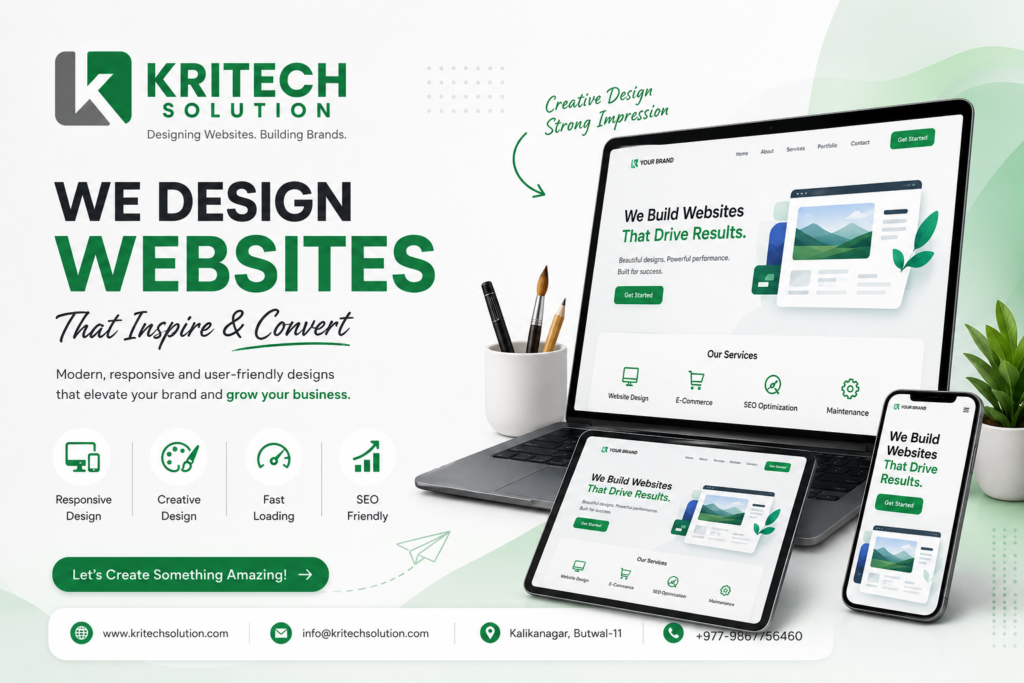
Think about the last website that made you instantly feel confident in a brand. That feeling did not happen by accident. Great website design is a deliberate, strategic craft that builds trust, drives action, and turns curious visitors into loyal customers.
If your current website is not doing all three of those things, you are leaving serious money on the table. At Kritech Solution, we create website design solutions that do not just look impressive. They perform. And in this article, we will show you exactly what separates a website that wins customers from one that quietly loses them.
What Is Website Design and Why Should Every Business Care?
Website design is far more than choosing colors and fonts. It is the complete architecture of how your website looks, feels, functions, and guides visitors toward taking action. Every layout decision, every button placement, every image choice, and every line of copy is part of the design.
Research shows that users form a judgment about a website's visual appeal and clarity typically within 50 milliseconds, and for 94% of users that initial impression hinges on design elements. Before a visitor reads your headline, checks your services, or considers your pricing, they have already decided whether your brand feels trustworthy.
According to the Stanford Persuasive Technology Lab, 46.1% of people say a website's design is the number one criterion for judging a company's credibility. Not your years of experience. Not your client list. Not your pricing. Your design. That is a powerful and humbling truth every business owner needs to sit with.
The Hidden Business Cost of a Poorly Designed Website
A bad website does not just look unprofessional. It actively drives customers away and sends them straight to your competitors. This is not a hypothetical risk. It is happening right now on poorly designed websites all over the world.
Nearly 75% of users judge a business's credibility based on its website design, and even a one-second delay in load time can reduce conversions by up to 20%. Speed is design. Performance is design. Every technical decision you make about your website is a design decision with real revenue consequences.
Research by the Nielsen Norman Group and Adobe confirms that design quality is among the top factors influencing user trust, and 59% of people say they prefer browsing beautifully designed content over something plain. Beautiful and functional website design is not a luxury. It is a competitive necessity.
Why First Impressions Determine Whether Visitors Stay or Leave
You have probably heard that you never get a second chance to make a first impression. Nowhere is that more true than on the web. Visitors make snap judgments, and once that initial feeling of doubt or disinterest settles in, it is almost impossible to recover.
A load time increase from just 1 second to 3 seconds can lead to a 32% rise in bounce rate, and 53% of mobile site visits are abandoned if pages take longer than 3 seconds to load. These are visitors who never even saw your offer. They left before the conversation started. That is the true cost of poor website design.
8 Website Design Secrets That Turn Visitors Into Customers
1. Design for Your Customer, Not Yourself
This is the mistake most business owners make. They design their website around their own preferences, company history, and internal structure rather than their customer's needs, questions, and decision journey. The result is a website that feels good to the owner and confusing to everyone else.
Great website design starts with deep empathy for the user. What does your ideal customer need to see first? What question are they trying to answer? What action do you want them to take? Build every page around those answers, and your website transforms from a brochure into a conversion machine.
2. Make Mobile Experience a Non-Negotiable Priority
Mobile devices now account for approximately 62.45% of all internet traffic worldwide, and businesses must adopt a mobile-first design approach to stay competitive. If your website looks and works beautifully on desktop but feels clunky on a phone, you are failing the majority of your visitors.
In 2025, 90% of all websites globally have implemented responsive design, and mobile users engage 15% more with responsive platforms, leading to longer sessions and better SEO rankings. Responsive website design is the floor, not the ceiling. Your mobile experience should be just as intentional, polished, and conversion-focused as your desktop experience. Hostinger
3. Speed Is a Design Feature, Not an Afterthought
Every extra second your website takes to load costs you visitors, leads, and sales. Page speed is one of the most overlooked elements of website design, and one of the most impactful on both user experience and search rankings.
When a page loads in 1 second, the average conversion rate is nearly 40%. At 3 seconds it drops to 29%, and by 6 seconds it reaches its lowest point. That is not a marginal difference. That is the gap between a thriving business and one that wonders why nobody is converting. Optimizing page speed is one of the highest-return investments you can make in your website design.
4. Build Trust Through Every Design Decision
Trust is not something you can fake with a flashy logo or a stock photo of a handshake. Real trust is built through consistent design quality, transparent information, genuine social proof, and clear communication at every touchpoint on your website.
According to the Nielsen Norman Group, the four factors that communicate website trustworthiness are design quality, up-front disclosure, comprehensive and current content, and connection to the rest of the web. These principles have held true for decades and continue to define what separates trusted websites from ones that visitors quietly exit without engaging.
5. Use Clear, Compelling Calls to Action on Every Page
Every page on your website exists for a reason. That reason should be expressed in a single, clear call to action that tells visitors exactly what to do next. Whether it is booking a consultation, downloading a guide, requesting a quote, or making a purchase, the path forward must be unmistakably obvious.
Research shows that personalized CTAs convert 42% more users than generic ones, and CTAs designed as buttons receive 45% more clicks than text links. Small design decisions like button shape, color, size, and placement can have enormous impacts on your conversion rate. Never treat your calls to action as an afterthought. Hostinger
6. Create Visual Hierarchy That Guides the Eye
Visual hierarchy is the art of arranging design elements so the eye naturally flows toward the most important information first. Done well, it is invisible to the user. Done poorly, visitors feel confused and overwhelmed without knowing exactly why.
The most effective website designs use size, contrast, color, whitespace, and placement to create a natural reading and decision path. Your headline grabs attention. Your subheading builds interest. Your body copy deepens understanding. Your call to action captures the conversion. Each step flows naturally into the next.
7. Let Your Content Do the Heavy Lifting
No amount of great visual design can save weak content. Your website copy needs to speak directly to your audience's pain points, desires, and questions in language that feels natural and human. Technical jargon, corporate speak, and overly formal language all create distance between your brand and your customer.
The best website designs make content the hero. Clean typography, generous white space, short paragraphs, and scannable subheadings all make your content easier to read and more persuasive. When design and content work together in harmony, conversions follow naturally.
8. Bake SEO Into Your Design From Day One
A beautiful website that nobody finds is a wasted investment. Search engine optimization and website design are not separate disciplines. They are deeply intertwined, and the decisions you make during design directly impact how well your site performs in search results.
URL structure, heading hierarchy, image optimization, page speed, internal linking, mobile responsiveness, and site architecture are all design decisions that carry major SEO implications. The most effective website design projects treat SEO as a core requirement from the very first wireframe, not a box to check after launch.
The Elements Every High-Converting Website Needs
Understanding the principles of great website design is one thing. Knowing how to execute them across every page of your site is another. High-converting websites share a set of core elements that work together to create a seamless, trustworthy, and persuasive experience.
A compelling homepage that immediately communicates your value proposition. Service or product pages that answer every question a buyer might have. An about page that builds genuine human connection. A contact page that removes every possible barrier to reaching out. And a blog or resource section that positions your brand as a trusted authority in your industry.
Each of these pages needs to be designed with both the user journey and search intent in mind. When every page serves a clear purpose and guides visitors naturally toward conversion, your website becomes your most powerful sales tool.
The Role of Color, Typography, and Imagery
Design details matter more than most people realize. Color psychology influences how visitors feel about your brand before they consciously process a single word. Typography affects readability, tone, and perceived professionalism. Imagery communicates personality, quality, and authenticity in a fraction of a second.
Inconsistent use of color, hard-to-read fonts, and low-quality images can quietly undermine even the strongest business offering. Conversely, a cohesive, thoughtful visual identity applied consistently across your website builds the kind of brand recognition and trust that makes conversion feel natural and effortless.
Website Design for E-Commerce: Turning Browsers Into Buyers
For businesses selling products or services online, website design carries even higher stakes. Every friction point in the shopping or inquiry experience is a potential drop-off. Every moment of confusion or doubt is a potential abandoned cart.
Strategic website development that focuses on removing barriers to conversion and incorporating psychological triggers can help e-commerce sites achieve significantly higher conversion rates than the 2 to 5% industry average. The difference between an average e-commerce site and a great one is almost entirely a design difference.
Product page design, checkout flow simplicity, trust signals near purchase buttons, clear returns policies, and mobile payment optimization are all critical design decisions that directly impact your bottom line. Getting them right requires expertise, testing, and a genuine understanding of how online buyers think and behave.
Website Design Trends Defining 2025
The digital landscape shifts constantly, and staying current with website design trends is not about vanity. It is about meeting rising user expectations and staying competitive in a market where the bar keeps moving higher.
Minimalist layouts that prioritize clarity over complexity are dominating in 2025. Micro-animations that provide subtle feedback and delight are becoming standard. Dark mode options are increasingly expected. AI-powered personalization is beginning to reshape what users experience when they land on a well-designed website.
Accessibility is another trend that has moved from nice-to-have to essential. A website that is not usable by people with visual, motor, or cognitive differences is excluding a significant segment of your potential audience. Building inclusivity into your website design from the start is both the right thing to do and a smart business decision.
The Growing Importance of Performance-Driven Design
The days of designing a website purely for aesthetics and worrying about performance later are firmly over. Today's best website design processes treat performance as a design constraint from the very beginning. Every element that gets added to a page must justify its presence in terms of both user value and loading impact.
Data consistently shows that page load speed is a direct driver of user retention, with conversion rates declining significantly as load times increase beyond one second. Designers and developers who understand this relationship and optimize for performance alongside aesthetics produce websites that are both beautiful and genuinely effective.
How to Brief a Website Design Project for the Best Results
One of the most common reasons website design projects go wrong is a poorly defined brief. The more clearly you can articulate your goals, audience, competitive landscape, and expectations before the project begins, the better the final result will be.
Start by defining who your ideal customer is and what they need from your website. Identify the three to five most important actions you want visitors to take. Research what your top competitors are doing well and where they fall short. Gather visual inspiration from websites you admire, even outside your industry.
The more context and clarity you give your website design team at the start, the less time is wasted on revisions and the more energy goes into building something genuinely excellent. A great brief is the foundation of a great website.
Setting Realistic Timelines and Expectations
A professionally designed website that performs well, ranks on Google, and converts visitors into customers takes time to build properly. Rushing the process to meet an arbitrary deadline almost always results in a weaker product that needs expensive fixing shortly after launch.
For most small to medium business websites, a realistic timeline from initial brief to launch is four to eight weeks. Complex e-commerce platforms or custom-built systems require more time. Investing that time upfront in thorough discovery, thoughtful design, rigorous testing, and proper SEO setup will save you far more time and money in the long run.
Why Kritech Solution Builds Website Design That Performs
At Kritech Solution, every website design project begins with a simple but powerful question: what does success look like for your business? That answer drives every decision we make from layout and navigation to content strategy and technical optimization.
We do not use cookie-cutter templates or one-size-fits-all approaches. Every website we design is custom-built around our client's brand, audience, goals, and market context. Whether you are a startup establishing your digital presence for the first time or an established business ready for a complete redesign, we bring the same level of care, expertise, and strategic thinking to every project.
Our website design process is collaborative, transparent, and results-focused. We keep you involved at every stage, explain every decision we make, and deliver a final product you are genuinely proud to share. More importantly, we deliver a website that works hard for your business long after launch day.
We also understand the specific needs and opportunities of the Nepal digital market. From local search optimization to culturally relevant design choices, we bring both global best practices and local insight to every project we take on.
The Direct Answer: What Makes an Excellent Website Design?
An excellent website design combines visual appeal, fast performance, mobile responsiveness, intuitive navigation, persuasive content, and strong calls to action into a seamless user experience. It builds trust instantly, guides visitors toward conversion naturally, and is optimized for search engines so the right people can find it. Great website design is simultaneously a branding tool, a sales tool, and a marketing tool working together as one.
Common Website Design Mistakes That Cost Businesses Customers
Even businesses that invest meaningfully in website design can fall into traps that quietly undermine their results. Knowing what these mistakes are is the first step to avoiding them.
Designing for internal stakeholders rather than end users is one of the most common and costly errors. When a website reflects the internal structure of a company rather than the mental model of a customer, visitors get lost, frustrated, and leave.
Neglecting website maintenance after launch is another expensive mistake. Outdated content, broken links, expired security certificates, and slow page speeds all erode the trust you worked hard to build. A website is a living asset that needs regular attention to stay effective.
Finally, treating website design and digital marketing as completely separate activities leads to missed opportunities. The most effective websites are built with SEO, content marketing, and conversion optimization baked in from the start. When design and marketing strategy work together, the results are dramatically better.
Frequently Asked Questions About Website Design
Q1: How much does professional website design cost in Nepal?
Website design costs in Nepal vary depending on the scope, features, and level of customization required. A clean professional business website typically starts at a very accessible price point, while fully custom e-commerce platforms or enterprise solutions require a larger investment. Kritech Solution offers honest, transparent pricing tailored to your actual business needs.
Q2: How long does a website design project take?
Most professional website design projects take 4 to 8 weeks from initial discovery to launch. Complex websites with advanced features, large product catalogs, or custom integrations may take longer. A thorough process upfront always produces a stronger result than one that is rushed.
Q3: What is the difference between website design and website development?
Website design focuses on the visual and experiential elements of a site including layout, color, typography, imagery, and user flow. Website development focuses on the technical build including coding, databases, integrations, and back-end functionality. Both disciplines need to work in close collaboration to produce a website that looks great and performs flawlessly.
Q4: Should I redesign my website or just update it?
If your website is more than 3 years old, is not mobile-friendly, loads slowly, or is generating fewer leads than it should, a full redesign is usually the smarter investment. Incremental updates on a fundamentally flawed foundation rarely produce the results a business needs. A fresh start with the right strategy delivers far better long-term ROI.
Q5: Can great website design actually improve my search rankings?
Absolutely. A well-designed user interface can increase a website's conversion rate by up to 200%, and the technical and structural decisions made during website design directly affect how Google evaluates and ranks your site. Mobile responsiveness, page speed, site architecture, and content structure are all design decisions with direct SEO consequences.
Ready for a Website Design That Actually Grows Your Business?
Your website should be working for you around the clock, making powerful first impressions, building trust, answering questions, and turning visitors into leads and customers. If your current site is not doing that, it is not a website. It is a missed opportunity.
Kritech Solution is ready to change that. Reach out today and let us design a website that your business and your customers will love, one that ranks, converts, and grows with you for years to come.
Contact Information
Kritech Solution
📍 Butwal-11, Kalikanagar
📞 9867756460
📧 info@kritechsolution.com
🌐 www.kritechsolution.com