You could have the most brilliantly written content in your industry and still rank nowhere near the first page of Google if your technical SEO is broken.
That is a hard truth many businesses discover only after months of publishing content and wondering why the traffic never comes. Technical SEO is the invisible infrastructure beneath your website that determines whether search engines can find, crawl, understand, and index your pages in the first place. Without it, everything else you invest in SEO, your content, your backlinks, your keyword strategy, simply cannot perform at its potential.
Think of technical SEO as the foundation of a building. The most beautiful interior design in the world means nothing if the foundation is cracked. Fix the foundation first, and everything built on top of it becomes dramatically more effective.
What Is Technical SEO and Why Is It Non-Negotiable?
Technical SEO refers to the process of optimizing your website's infrastructure so search engines can crawl and index it efficiently, understand its content accurately, and deliver it to users with the best possible experience.
Unlike content creation or link building, technical SEO operates largely behind the scenes. It covers everything from how fast your pages load and how your site is structured, to whether search engines can even access your pages without running into errors.
According to Google Search Central, ensuring that Google can discover and index your pages correctly is one of the foundational requirements for any website that wants to rank. No amount of content quality or backlink authority can compensate for a website that search engine crawlers cannot properly access and understand.
For growing businesses in Nepal and beyond, technical SEO is not an advanced optional extra. It is the essential starting point for every other SEO effort to actually work.
The Real Cost of Ignoring Technical SEO
Many businesses treat technical SEO as something to deal with later, after the content is written and the links are built. This is one of the most expensive SEO mistakes you can make.
A single critical technical issue, like a misconfigured robots.txt file accidentally blocking search engine crawlers, can prevent your entire website from appearing in search results. Slow page load times quietly drive away visitors and suppress rankings at the same time. Duplicate content issues confuse search engines and dilute the authority of your best pages.
According to Ahrefs, the majority of websites audited have significant technical SEO issues holding back their organic performance, many of which go completely undetected without a proper technical audit. The businesses that catch and fix these issues early gain a compounding ranking advantage their competitors never recover from.
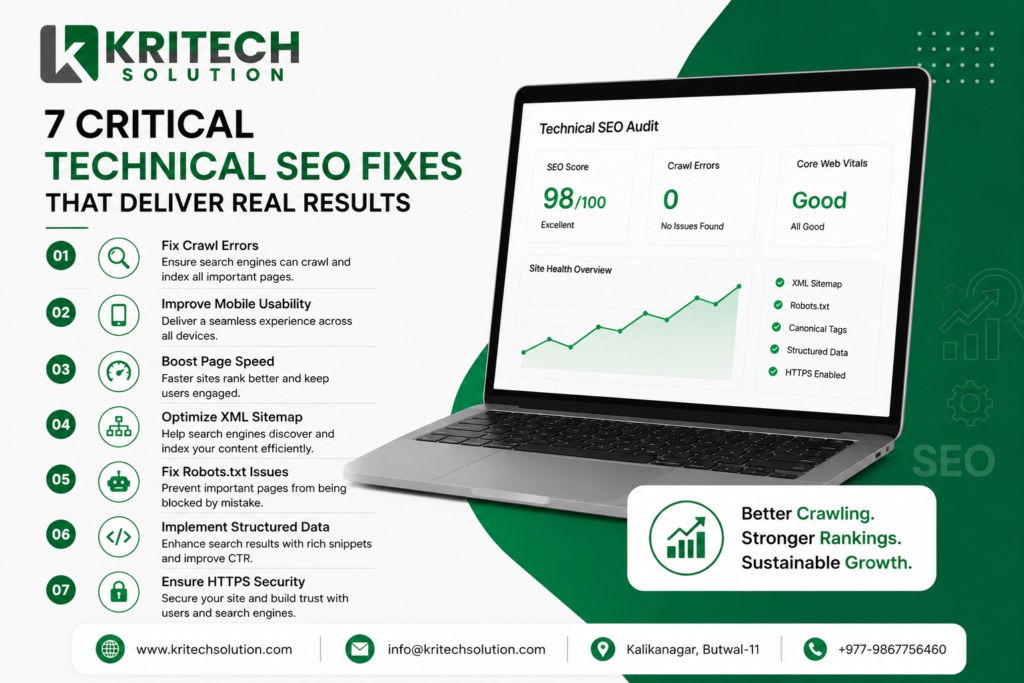
7 Critical Technical SEO Fixes That Deliver Real Results
1. Fix Crawl Errors and Ensure Full Indexability
The very first question technical SEO answers is whether search engines can actually access your website. Crawl errors occur when Google's bots attempt to visit a page and encounter a problem, whether that is a broken link leading to a 404 error, server errors, or pages accidentally blocked by your robots.txt file.
Google Search Console is your most important tool here. Regularly auditing your coverage report reveals exactly which pages are indexed, which are excluded, and which are encountering errors. Every crawl error is a missed opportunity for a page that could be ranking and driving traffic.
2. Optimize Your XML Sitemap for Maximum Crawl Efficiency
An XML sitemap is essentially a roadmap you provide to search engines, listing all the important pages on your website that you want crawled and indexed. A well-structured sitemap helps Google discover your content faster, understand your site architecture more clearly, and prioritize crawling your most valuable pages.
Your sitemap should only include canonical, indexable pages. Including redirected URLs, noindex pages, or broken links in your sitemap wastes crawl budget and sends confusing signals to search engines. Submit your sitemap directly through Google Search Console and keep it updated whenever significant content changes are made.
3. Implement HTTPS and Resolve Mixed Content Issues
Website security is a confirmed Google ranking signal. Sites running on HTTPS, which encrypts data between the server and the visitor's browser, receive a ranking boost over HTTP equivalents. More importantly, browsers like Chrome now actively warn users when they visit non-secure websites, which devastates trust and dramatically increases bounce rates.
Mixed content issues occur when an HTTPS page loads some resources, such as images, scripts, or stylesheets, over HTTP. These issues undermine your security implementation and can trigger browser warnings even on technically secure pages. Resolving every mixed content issue ensures your security signals are clean and complete.
4. Eliminate Duplicate Content With Canonical Tags
Duplicate content is one of the most common and damaging technical SEO issues websites face. When multiple URLs display identical or very similar content, search engines struggle to determine which version deserves to rank. The result is diluted page authority and unpredictable ranking behavior across your most important pages.
The canonical tag is the technical SEO solution. By adding a rel canonical element to the head of each page, you explicitly tell search engines which version of a URL is the authoritative one that should receive all ranking credit. This is particularly important for e-commerce websites where product filtering and sorting parameters frequently generate hundreds of duplicate URL variations.
5. Achieve Outstanding Core Web Vitals Scores
Core Web Vitals became an official Google ranking factor in 2021 and have grown in importance with every subsequent algorithm update. These three metrics measure the real-world user experience your website delivers: Largest Contentful Paint for loading speed, First Input Delay for interactivity responsiveness, and Cumulative Layout Shift for visual stability during page load.
According to Google, pages that pass Core Web Vitals assessments provide a measurably better user experience and are rewarded with a ranking advantage in competitive search results. Achieving good scores requires a combination of server optimization, efficient code, properly sized images, and eliminating render-blocking resources.
6. Build a Logical and Crawlable Site Architecture
How your website is organized and how pages link to each other has a profound impact on both user experience and technical SEO performance. A flat, logical site architecture ensures search engine crawlers can reach every important page on your site within a few clicks from the homepage.
Pages buried deep in a complex site structure receive less crawl attention and accumulate less internal link authority than pages that are easy to discover. The general rule is that no important page should be more than three clicks away from your homepage. Clear navigation, consistent internal linking, and a thoughtful URL structure all contribute to a site architecture that search engines and users can navigate effortlessly.
7. Optimize for Mobile-First Indexing
Google now uses the mobile version of your website as the primary basis for indexing and ranking. This shift to mobile-first indexing means that if your mobile experience is slower, thinner in content, or structurally different from your desktop version, your rankings will reflect the weaker mobile performance regardless of how good your desktop site is.
Every element of your technical SEO strategy must be evaluated through a mobile lens first. Responsive design, touch-friendly navigation, fast mobile load times, and properly sized viewport settings are not optional enhancements. They are technical SEO requirements that directly determine how well your site ranks across all devices.
Structured Data: The Technical SEO Advantage Most Businesses Miss
Structured data markup, implemented through Schema.org vocabulary, is one of the most powerful and consistently underused technical SEO opportunities available. By adding structured data to your pages, you provide search engines with explicit, machine-readable information about your content, your business, your products, your reviews, and your events.
This explicit context helps Google understand your pages with far greater precision and opens the door to rich results in search, including star ratings, FAQ dropdowns, product pricing, event details, and more. Rich results dramatically increase click-through rates by making your listing stand out visually from every other result on the page.
For businesses in Nepal, implementing structured data for local business information, including business name, address, phone number, opening hours, and service area, is a technical SEO move that strengthens local search visibility in ways that no amount of content alone can achieve.
Technical SEO Audits: How to Find What Is Holding Your Website Back
The only way to know exactly which technical SEO issues are affecting your website is through a comprehensive technical audit. This process systematically examines every aspect of your site's technical health, from crawlability and indexation to page speed, security, structured data, and mobile performance.
A thorough technical SEO audit typically uncovers issues that website owners had no idea existed, broken internal links quietly draining page authority, pages accidentally set to noindex that should be ranking, images without alt text missing image search traffic, and redirect chains slowing down crawl efficiency.
At Kritech Solution, technical SEO audits are the starting point for every SEO engagement. Understanding exactly what is holding a website back allows the team to prioritize fixes by impact, so the issues causing the most ranking damage get resolved first and the results start coming faster.
Technical SEO in Nepal: Building the Digital Foundation Your Business Needs
Nepal's digital marketplace is growing at a pace that rewards businesses who invest in strong technical foundations now rather than scrambling to fix problems later. As competition for organic search visibility intensifies across every industry, the technical quality of your website becomes an increasingly powerful differentiator.
According to HubSpot, companies that prioritize technical website performance alongside content and link building achieve significantly stronger organic growth than those that treat technical SEO as a secondary concern. The businesses leading organic search in Nepal's competitive digital landscape share one thing in common: they built their SEO on a technically sound foundation.
Whether you are building a new website from scratch or auditing an existing one that has never been technically optimized, addressing technical SEO is the single highest-leverage investment you can make in your long-term organic performance.
Frequently Asked Questions About Technical SEO
Q: What is the difference between technical SEO and on-page SEO?
On-page SEO focuses on optimizing the visible content elements of your pages, including titles, headings, keyword usage, and content quality. Technical SEO addresses the underlying infrastructure that determines whether search engines can access, crawl, and index your pages correctly. Both are essential and work together as complementary layers of a complete SEO strategy.
Q: How do I know if my website has technical SEO problems?
The most reliable way is through a professional technical SEO audit using tools like Google Search Console, Screaming Frog, Ahrefs, or Semrush. These tools systematically identify crawl errors, indexation issues, page speed problems, duplicate content, broken links, and dozens of other technical issues that could be suppressing your rankings without any obvious visible symptoms.
Q: How often should I perform a technical SEO audit?
A comprehensive technical audit should be performed at minimum once per year, and ideally every six months for actively growing websites. Additionally, a targeted technical review should be conducted whenever significant changes are made to your website, such as a redesign, platform migration, or major content restructuring. Technical issues introduced during site changes are one of the most common causes of sudden ranking drops.
Q: Does page speed really affect my Google rankings?
Yes, definitively. Page speed is a confirmed Google ranking factor, and its importance was formalized through the introduction of Core Web Vitals as ranking signals. Beyond rankings, faster pages deliver measurably better user experiences with lower bounce rates, higher engagement, and stronger conversion rates. Page speed optimization is one of the few technical SEO improvements that simultaneously benefits search performance and business results.
Q: Can technical SEO issues cause my website to completely disappear from Google?
Yes, in serious cases. A robots.txt file configured to block all search engine crawlers, pages incorrectly tagged with noindex directives, or a manual penalty from Google can cause pages or entire websites to vanish from search results entirely. This is why regular technical monitoring through Google Search Console is essential for any business that depends on organic search traffic.
Ready to Build a Website That Google Loves and Customers Trust?
Technical SEO is not the most glamorous part of digital marketing. But it is the part that makes everything else actually work.
Every piece of content you create, every backlink you earn, and every on-page optimization you implement performs at a fraction of its potential until the technical foundation beneath it is solid. The businesses that understand this invest in technical SEO early and reap compounding organic rewards for years to come.
Kritech Solution brings the technical expertise, the diagnostic tools, and the proven process to identify exactly what is holding your website back and fix it the right way. Reach out today and let us build the technical SEO foundation your business deserves.
Contact Information
Kritech Solution
📍 Butwal-11, Kalikanagar
📞 9867756460
📧 info@kritechsolution.com
🌐 www.kritechsolution.com