Introduction
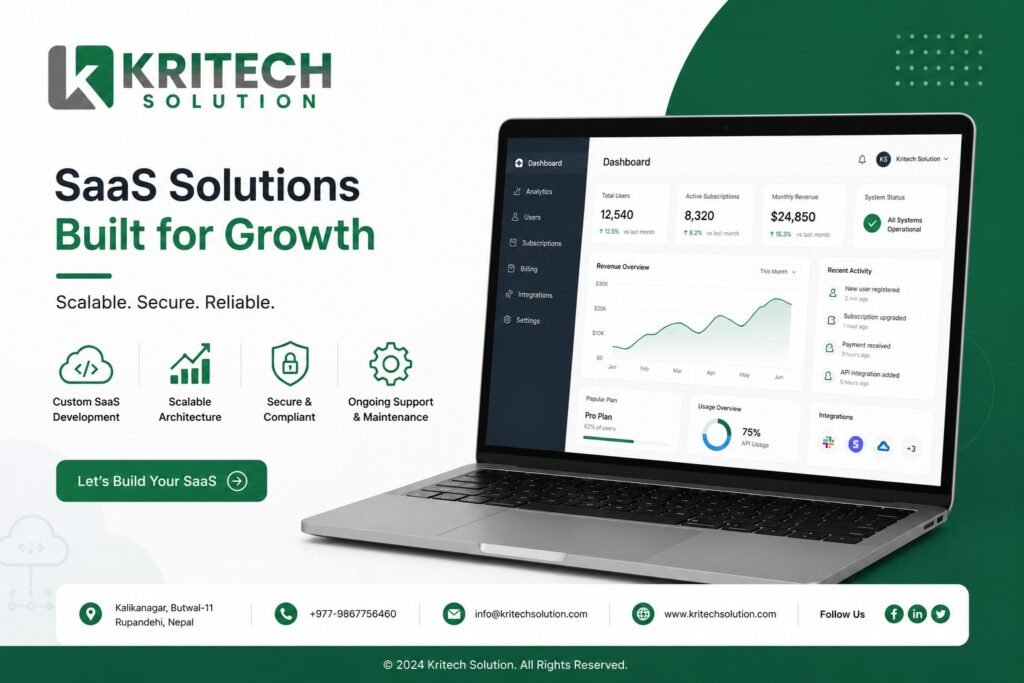
SaaS development is one of the most exciting and financially rewarding paths in software today, and businesses that understand how to build it right are quietly creating recurring revenue machines that grow while they sleep. If you have a software idea, a business process worth productizing, or an existing tool that deserves a smarter delivery model, the SaaS architecture might be the most important decision you make this year.
The global SaaS market is projected to reach over $700 billion by 2030 according to Statista, and that trajectory is not slowing down. Businesses of every size are replacing one-time software purchases with subscription-based cloud solutions because the value, flexibility, and cost efficiency are simply undeniable. Getting into this space now, while growth is still accelerating, is a genuine opportunity that sharp entrepreneurs and businesses in Nepal and globally are already capitalizing on.
This guide walks you through everything that matters in SaaS development, from architecture decisions and technology choices to go-to-market strategy and long-term scaling.
What Is SaaS Development and Why Is It Dominating Software in 2025?
SaaS development is the process of building software that is hosted in the cloud and delivered to users over the internet on a subscription basis rather than installed locally on individual machines. Instead of buying a license and managing your own infrastructure, users pay a monthly or annual fee to access the software from any device, anywhere, at any time.
The appeal from a business model perspective is enormous. Traditional software sales are transactional and unpredictable. A customer buys once and you never hear from them again unless something breaks. SaaS flips that model completely. Every subscriber generates recurring revenue month after month, your customer relationships deepen over time, and your ability to forecast revenue becomes dramatically more reliable.
From the user perspective, SaaS products offer automatic updates, no installation headaches, seamless collaboration across teams and locations, and the ability to scale usage up or down based on actual needs. That combination of convenience and flexibility is why SaaS has become the default delivery model for virtually every category of business software.
Planning Your SaaS Product: The Foundation That Determines Everything
The most common and most costly mistake in SaaS development is rushing into building before the product is properly defined. Developers who jump straight into writing code without a validated product concept and clearly mapped user journey almost always end up rebuilding large parts of their product within the first year, wasting months of time and significant budget in the process.
Start with ruthless clarity about the problem you are solving and exactly who you are solving it for. The most successful SaaS products are not the ones trying to do everything for everyone. They are the ones that solve one specific, painful problem for a clearly defined audience better than anything else available. That focus is what drives initial adoption, word-of-mouth growth, and the kind of customer loyalty that powers long-term subscription retention.
User research at this stage is not optional. Talk to your potential customers. Understand their current workflow, where the friction points are, what workarounds they are currently using, and how much they would genuinely pay to make those pain points disappear. The insights from even ten to fifteen honest conversations will shape your product roadmap in ways that save you enormous amounts of time and money during development.
Define your Minimum Viable Product with genuine discipline. Your MVP should include the smallest possible feature set that delivers real, measurable value to your earliest users. Everything else goes on the roadmap for future releases. Scope creep during MVP development is one of the leading causes of SaaS projects going over budget and over deadline before they ever reach a single paying customer.
Choosing the Right Tech Stack for SaaS Development
Your technology choices in SaaS development will shape your product's performance, scalability, security, and the speed at which your team can ship new features for years to come. Getting this decision right from the beginning matters enormously, but it does not need to be paralyzingly complex.
For the frontend, React and Next.js have become the dominant choices for SaaS products that need fast, dynamic, highly interactive user interfaces. Vue.js is another strong option, particularly for smaller teams that prioritize development speed and simplicity. Both ecosystems are mature, well-supported, and have massive communities that make finding developers and solving technical challenges significantly easier.
On the backend, Node.js with Express or NestJS, Python with Django or FastAPI, and Ruby on Rails each have strong track records powering successful SaaS products at scale. The right choice depends on your team's existing expertise, your performance requirements, and the specific technical demands of your product. Choosing a stack your team already knows well almost always beats choosing the theoretically superior stack that nobody on your team has deep experience with.
Cloud infrastructure choices are equally important. AWS, Google Cloud, and Microsoft Azure are the three dominant platforms, each with comprehensive services for compute, storage, databases, authentication, and everything else a modern SaaS product needs. Most early-stage SaaS products start on a single cloud provider and add complexity only as genuine scale demands it. According to Forrester Research, over 94 percent of enterprise companies now use cloud services, and the tooling, documentation, and community support available on major cloud platforms have never been better.
Database architecture deserves particular attention in SaaS development because multi-tenant data management introduces complexity that does not exist in single-user software. Decide early whether you will use a shared database with row-level tenant isolation, separate schemas per tenant, or completely separate databases per tenant. Each approach involves different trade-offs between cost, complexity, security, and scalability that will affect your product for years.
SaaS Development Architecture: Building for Scale From Day One
One of the unique challenges of SaaS development is that you are building software that needs to work reliably for one user today and potentially thousands of simultaneous users eighteen months from now. Designing your architecture to handle that growth without requiring a complete rebuild is one of the most important engineering decisions you will make.
Microservices architecture has become the standard approach for SaaS products that expect significant scale. Instead of building a monolithic application where all functionality is tightly coupled together, microservices break the product into independent, loosely coupled services that can be developed, deployed, and scaled independently. This approach makes your system more resilient, easier to maintain, and significantly more scalable as your user base grows.
API-first design is another architectural principle that pays enormous dividends in SaaS development. Building your backend as a clean, well-documented API from the start gives you the flexibility to build web and mobile interfaces on top of the same infrastructure, enable third-party integrations, and create partner ecosystems that extend your product's value without requiring your core team to build everything themselves.
Security and data privacy need to be architected into your SaaS product from the very beginning, not bolted on as an afterthought once you have paying customers. Multi-tenant data isolation, end-to-end encryption, role-based access control, audit logging, and compliance with relevant data protection regulations are not optional features. They are the foundation of the customer trust that your subscription business model absolutely depends on.
SaaS Pricing Strategy: Turning Great Software Into Reliable Revenue
Building a technically excellent SaaS product and pricing it incorrectly is one of the most common ways talented development teams fail to build sustainable businesses. Pricing in SaaS is not just a number you put on a webpage. It is a fundamental expression of your product's value, your target market's willingness to pay, and the growth model your business is built around.
The three most widely used SaaS pricing models each have distinct advantages depending on your product type and market. Per-seat pricing, where customers pay a fixed amount per user per month, works brilliantly for collaboration tools and productivity software where value scales directly with team size. Usage-based pricing, where customers pay based on consumption, aligns your revenue perfectly with the value customers receive and dramatically reduces the barrier to initial adoption. Tiered pricing packages features and capabilities into distinct plans at different price points, which lets you capture value from customers across a wide range of willingness to pay.
Annual prepayment discounts are a powerful cash flow tool that most SaaS businesses underutilize early in their growth. Offering customers 15 to 20 percent off in exchange for paying annually rather than monthly gives you predictable upfront cash, reduces churn risk significantly, and simplifies your revenue forecasting. According to HubSpot's SaaS metrics research, SaaS companies with strong annual plan adoption consistently show higher net revenue retention and lower customer acquisition costs than those operating primarily on monthly subscriptions.
Freemium models deserve careful consideration and careful execution. A well-designed freemium tier can be a powerful acquisition channel that gets your product into users' workflows before asking for any payment. The critical discipline is ensuring your free tier delivers genuine value without undermining the compelling reasons to upgrade to a paid plan. Getting this balance wrong either produces a free product with no upgrade path or a crippled free tier that drives no adoption.
User Onboarding: The Make-or-Break Moment in SaaS Development
You can build the most technically sophisticated SaaS product in your category and still fail spectacularly if your user onboarding experience is confusing, slow, or underwhelming. The first five to ten minutes a new user spends in your product determines whether they become an engaged customer who stays for years or a churned trial that never comes back.
Great SaaS onboarding is not a tutorial. It is an experience carefully engineered to deliver one specific outcome: the moment the user genuinely feels the value of your product for the first time. Product teams call this the "aha moment" and designing your entire onboarding flow around getting users there as quickly and effortlessly as possible is one of the highest-leverage investments you can make in your SaaS product.
Progressive disclosure, where you introduce features gradually as users are ready for them rather than overwhelming them with every capability on day one, is the onboarding philosophy that consistently produces the best activation and retention results. Guide new users to one meaningful win in their first session, then build from there. Each small success deepens their investment in your product and makes churning increasingly less attractive.
In-app tooltips, interactive product tours, empty state guidance, and proactive email sequences triggered by user behavior all work together to create an onboarding experience that feels supportive rather than intrusive. The SaaS products with the lowest churn rates almost universally invest heavily in onboarding infrastructure because they understand that retention starts at the very first login.
Scaling a SaaS development: What Changes When Growth Accelerates
The technical and operational challenges of running a SaaS development with 100 customers are genuinely different from those at 1,000 customers, and dramatically different again at 10,000. Building with scale in mind from the start is important, but so is understanding which scaling challenges to solve now versus which ones to address when they actually materialize.
Performance optimization becomes non-negotiable as your user base grows. Database query optimization, caching strategies, content delivery networks, and load balancing are all tools that transform a sluggish experience under load into a fast, reliable product that users trust. Slow SaaS development churn customers silently and consistently. Users rarely complain about performance. They just stop logging in.
Customer success infrastructure scales differently than technology infrastructure but is equally critical to sustainable SaaS development growth. As your customer base grows, systematic onboarding, proactive health monitoring, renewal management, and expansion revenue programs become the operational backbone that keeps net revenue retention above 100 percent, the metric that separates the SaaS development businesses that compound into industry leaders from those that plateau and struggle.
At Kritech Solution, we have worked with entrepreneurs and businesses across Nepal to design, build, and launch SaaS products that are architected for real scale from day one. Our team brings together product strategy, technical architecture, UI and UX design, and full-stack development into a coherent process that takes you from validated idea to live, revenue-generating product with the efficiency and quality that early SaaS traction demands.
Frequently Asked Questions About SaaS Development
Q1: What is SaaS development and how is it different from traditional software development?
SaaS development is the process of building cloud-hosted software delivered to users via subscription over the internet. Unlike traditional software that is installed locally and sold as a one-time license, SaaS products are continuously updated, accessible from any device, and generate recurring subscription revenue. The architecture, business model, and growth dynamics are fundamentally different from traditional software in ways that affect every aspect of how the product is built and operated.
Q2: How much does it cost for SaaS development?
SaaS development costs vary enormously based on product complexity, feature scope, technology choices, and team composition. A well-scoped MVP built by an experienced development partner typically ranges from $15,000 to $80,000 depending on complexity. More sophisticated products with advanced integrations, custom infrastructure, and extensive UX work can cost significantly more. Investing in thorough planning and a realistic scope before development begins is the single most effective way to control costs without compromising quality.
Q3: How long does SaaS development take from idea to launch?
A focused MVP with a clearly defined scope typically takes 3 to 6 months to design, develop, test, and deploy. More complex products with extensive feature sets, multiple integrations, and sophisticated multi-tenant architecture can take 6 to 12 months or more. Timeline depends heavily on how well-defined the requirements are at the start, the experience level of the development team, and how efficiently decisions are made throughout the process.
Q4: What technology stack is best for SaaS development in 2025?
There is no single best stack, but the most widely proven combination for SaaS development products in 2025 is React or Next.js on the frontend, Node.js or Python on the backend, PostgreSQL or MongoDB for the database, and AWS or Google Cloud for infrastructure. The most important factor is choosing technologies your development team knows deeply rather than chasing the latest trends. Execution quality always matters more than technology choice.
Q5: How do I validate my SaaS idea before investing in full SaaS development?
Start by talking directly to 10 to 20 people who match your target customer profile and understanding their pain points in depth. Build a simple landing page describing your product and measure genuine interest through email signups or waitlist registrations. Consider building a no-code or low-code prototype that lets potential customers experience the core workflow before committing to full development. Real customer validation before significant development investment is the single most reliable way to avoid building something the market does not actually want.
The SaaS opportunity has never been bigger, the tools have never been more accessible, and the market appetite for well-built subscription software has never been stronger. But the difference between a SaaS product that builds real recurring revenue and one that burns through budget without finding traction almost always comes down to the quality of the thinking, planning, and execution behind it.
Kritech Solution brings the technical depth, product thinking, and real-world development experience to help you build a SaaS product that works the way you envisioned it, scales the way your business needs it to, and delivers the recurring revenue that makes software businesses so uniquely valuable. Reach out today and let's turn your SaaS idea into a product your customers will not want to live without.
Contact Information
Kritech Solution
📍 Butwal-11, Kalikanagar
📞 9867756460
📧 info@kritechsolution.com
🌐 www.kritechsolution.com