If your website is not showing up on the first page of Google, on-page SEO is the first place you need to look.
Every business wants more organic traffic. More visibility. More customers finding them without paying for every single click. But most websites are quietly sabotaging their own rankings with on-page mistakes that are completely fixable once you know what to look for.
On-page SEO is the practice of optimizing individual web pages so search engines understand exactly what your content is about and why it deserves to rank. Get it right, and Google rewards you with consistent, compounding organic traffic. Get it wrong, and even the best content stays buried on page three where almost nobody looks.
What Is On-Page SEO and Why Does It Form the Foundation of Your Rankings?
On-page SEO refers to every optimization you make directly on your web pages to improve their visibility in search engine results. This includes your content quality, keyword placement, title tags, meta descriptions, heading structure, internal linking, image optimization, page speed, and much more.
Unlike off-page SEO, which depends on external factors like backlinks and brand mentions, on-page SEO is entirely within your control. That makes it the most immediate and actionable lever you have for improving your search performance.
According to Google's Search Central documentation, helping Google understand your content clearly is one of the most important things you can do to improve your rankings. On-page SEO is precisely how that understanding is built.
For businesses in Nepal and globally, mastering on-page SEO means your website starts working smarter, not just harder, for every customer searching for what you offer.
The Core Principle Behind Effective On-Page SEO
Before jumping into tactics, it helps to understand the philosophy that makes on-page SEO work at a deeper level. Google's entire mission is to deliver the most relevant, helpful, and trustworthy result for every search query.
Your job with on-page SEO is to make it unmistakably clear to Google that your page is the best possible answer to a specific question or search intent. Every technique covered in this article serves that single purpose.
When your page genuinely serves the searcher better than competing pages, and communicates that value clearly through proper optimization, rankings follow naturally and consistently.
7 Powerful On-Page SEO Techniques That Deliver Real Results
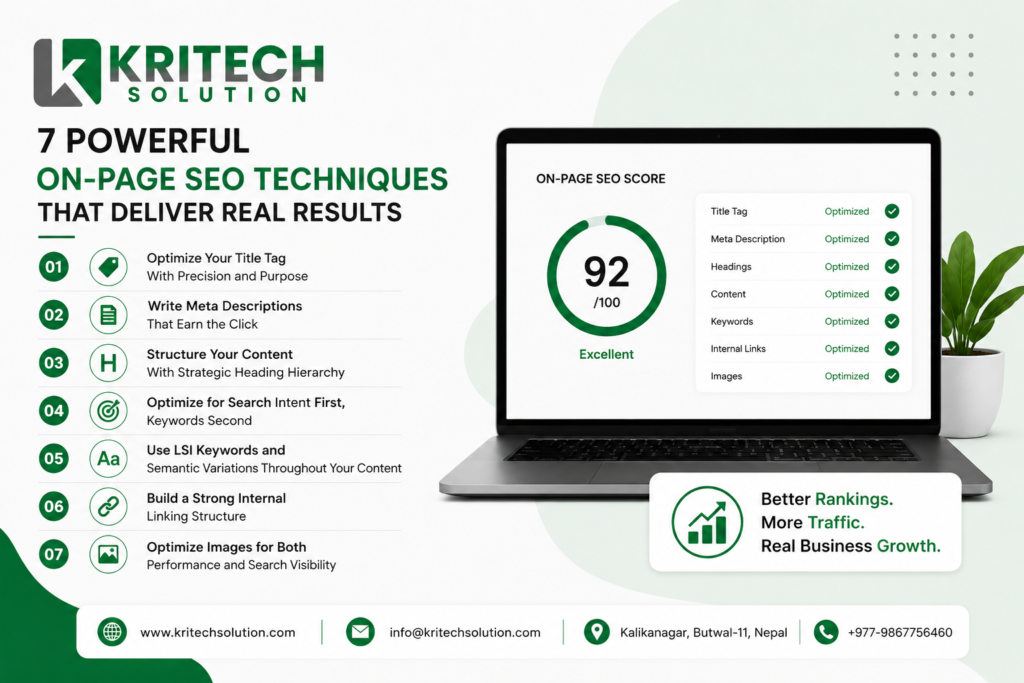
1. Optimize Your Title Tag With Precision and Purpose
Your title tag is the single most important on-page SEO element on any page. It tells search engines and users exactly what your page is about, and it is the first thing people see in search results before deciding whether to click.
Every title tag should include your primary keyword as naturally as possible, ideally toward the beginning. It should stay under 60 characters to avoid being truncated in search results and include a compelling reason for the user to click through.
2. Write Meta Descriptions That Earn the Click
Your meta description does not directly influence rankings, but it has an enormous impact on your click-through rate, which absolutely does influence how Google evaluates your page over time.
A strong meta description summarizes the page content clearly, includes your focus keyword naturally, creates genuine curiosity or urgency, and stays between 150 and 160 characters. Think of it as a micro advertisement for your page in the search results.
3. Structure Your Content With Strategic Heading Hierarchy
Headings are not just for visual organization. They are a critical on-page SEO signal that helps search engines understand the structure, depth, and relevance of your content.
Use a single H1 tag that includes your primary keyword and clearly states what the page covers. Follow with H2 headings for main sections and H3 headings for subsections within those. This hierarchical structure signals to Google that your content is thorough, well-organized, and genuinely useful.
4. Optimize for Search Intent First, Keywords Second
This is where many businesses get on-page SEO fundamentally wrong. They stuff keywords into their content without ever asking the most important question: what does this person actually want to find when they type this search query?
According to Ahrefs, matching search intent is one of the most critical ranking factors in modern SEO. Google categorizes search intent into four types: informational, navigational, commercial, and transactional. Every page you optimize must first and foremost satisfy the specific intent behind the keyword it targets.
5. Use LSI Keywords and Semantic Variations Throughout Your Content
Modern search engines do not just look for exact keyword matches. They analyze the entire context of your content to determine whether it comprehensively covers a topic.
LSI keywords, which stands for Latent Semantic Indexing, are conceptually related terms and phrases that signal topical depth and relevance. For an article about on-page SEO, related semantic terms might include title tags, meta descriptions, internal linking, keyword density, page speed, and content optimization. Weaving these naturally throughout your content tells Google your page covers the topic with real authority.
6. Build a Strong Internal Linking Structure
Internal links are one of the most underused on-page SEO techniques available. They distribute page authority throughout your website, help search engines discover and index your content more efficiently, and guide visitors naturally toward related content that keeps them engaged longer.
Every internal link should use descriptive anchor text that tells both users and search engines exactly what the linked page is about. Generic anchor text like click here or read more wastes an opportunity that could be strengthening your site architecture with every single link.
7. Optimize Images for Both Performance and Search Visibility
Images make content more engaging and shareable, but unoptimized images quietly destroy page speed and miss valuable SEO opportunities. Every image on your website should have a descriptive, keyword-relevant file name and a thoughtfully written alt text attribute.
According to Google, well-optimized images can appear in Google Image Search results, creating an additional traffic channel many businesses never tap into. Beyond visibility, compressed images that load quickly contribute directly to better Core Web Vitals scores, which Google uses as a direct ranking signal.
Content Quality: The Heart of Every On-Page SEO Strategy
All the technical optimization in the world will not save content that fails to genuinely serve its reader. Google's helpful content system is specifically designed to reward pages that prioritize people over search engines.
That means every page you optimize should answer the searcher's question completely, provide unique insights or perspectives that go beyond surface-level information, and be written in a way that feels natural, clear, and genuinely useful rather than keyword-stuffed and robotic.
The businesses that consistently win in organic search are the ones that treat on-page SEO and content quality as inseparable partners rather than competing priorities. Technical optimization amplifies great content. It cannot rescue poor content.
Page Speed and Core Web Vitals: The Technical Side of On-Page SEO
Page speed is not just a user experience issue. It is a confirmed Google ranking factor, and its importance has grown significantly since the introduction of Core Web Vitals as an official ranking signal.
Core Web Vitals measure three specific aspects of page experience: Largest Contentful Paint, which measures loading performance; First Input Delay, which measures interactivity; and Cumulative Layout Shift, which measures visual stability. Pages that perform well across all three metrics earn a measurable ranking advantage over slower competitors.
According to HubSpot, a one-second delay in page load time can reduce conversions by up to 7%. Fast pages rank better and convert better at the same time, making page speed optimization one of the highest-return investments in your entire on-page SEO strategy.
On-Page SEO for Businesses in Nepal: A Competitive Edge Worth Seizing
The on-page SEO landscape in Nepal presents a remarkable opportunity for businesses willing to invest in getting it right. Most websites competing for local and national keywords are not properly optimized, leaving significant ranking opportunities open for businesses that take on-page SEO seriously.
At Kritech Solution, every website project includes a comprehensive on-page SEO foundation built from the ground up. From keyword mapping and content architecture to technical optimization and internal linking strategy, the approach is thorough, data-driven, and built for long-term organic growth.
Whether you are launching a new website or optimizing an existing one, getting your on-page SEO right from the start is always more cost-effective than trying to fix it later.
Frequently Asked Questions About On-Page SEO
Q: What is the most important on-page SEO factor?
Content quality and relevance to search intent are the most important on-page SEO factors overall. However, title tags, heading structure, and page speed are close behind. The reality is that effective on-page SEO is a combination of multiple elements working together rather than any single magic factor. Neglecting any major area weakens the overall result.
Q: How often should I update my on-page SEO?
On-page SEO should be reviewed and updated regularly, ideally every three to six months for key pages. Search intent evolves, competitors update their content, and Google's algorithm continues to refine what it considers the best answer for any given query. Pages that are regularly refreshed with updated information tend to maintain and improve their rankings over time.
Q: What is keyword density and how important is it?
Keyword density refers to how frequently your focus keyword appears relative to the total word count of your content. A natural density of around 1% to 1.5% is generally recommended. More important than hitting a specific percentage is ensuring your keyword appears in the most impactful locations: your title tag, H1 heading, first paragraph, at least one H2 subheading, and naturally throughout the body content.
Q: Does on-page SEO work without off-page SEO?
On-page SEO creates the foundation that makes ranking possible, but for competitive keywords, off-page SEO factors like backlinks and domain authority are usually needed to break into the top positions. For less competitive local or niche keywords, strong on-page SEO alone can often achieve first-page rankings. The two strategies always work best together as a unified approach.
Q: How do I know if my on-page SEO is working?
The clearest indicators are improvements in organic search rankings for your target keywords, increases in organic traffic from Google Search Console, and improvements in Core Web Vitals scores. Tracking these metrics consistently over time gives you a clear picture of whether your on-page SEO efforts are delivering measurable results.
Ready to Turn Your Website Into an Organic Traffic Machine?
Your competitors are optimizing their pages right now. Every day your website runs without a solid on-page SEO strategy is a day you are handing potential customers to businesses that invested in getting this right.
On-page SEO is not a one-time task. It is an ongoing commitment to making your website the clearest, fastest, most helpful answer to the questions your customers are already asking Google. And when you get it right, the results are consistent, compounding, and genuinely transformational for your business.
Kritech Solution is ready to build an on-page SEO strategy that drives real organic growth for your business. Reach out today and let us put your website exactly where your customers are looking.
Contact Information
Kritech Solution
📍 Butwal-11, Kalikanagar
📞 9867756460
📧 info@kritechsolution.com
🌐 www.kritechsolution.com