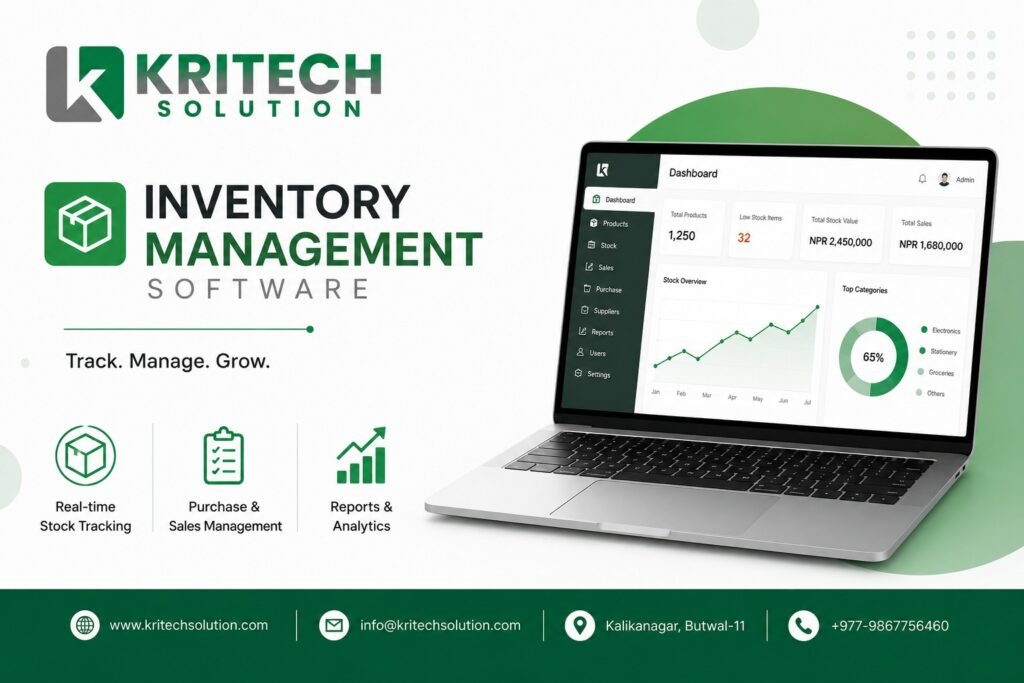
Every business that sells physical products knows the quiet panic of discovering a bestselling item is out of stock the moment a customer tries to buy it. Or the slow financial drain of warehouses packed with products that are not moving. These are not small problems. They are symptoms of a business running without proper inventory management software.
Inventory management is the backbone of any product-based business, and yet so many companies in Nepal and around the world are still managing their stock through spreadsheets, handwritten ledgers, or outdated systems that create more confusion than clarity. The result is lost sales, wasted capital, unhappy customers, and business owners spending their most valuable hours manually counting stock instead of growing their company.
The right inventory management software does not just organize your stock. It transforms the way your entire business operates, from purchasing and warehousing to sales, customer service, and financial planning.
What Is Inventory Management Software and Why Does Every Product Business Need It?
Inventory management software is a digital system that tracks, manages, and optimizes the flow of goods through your business, from the moment stock arrives at your warehouse to the moment it reaches your customer. It provides real-time visibility into stock levels, automates reorder processes, tracks product movement across multiple locations, and generates the insights your business needs to make smarter purchasing and sales decisions.
Modern inventory management software goes far beyond simple stock counting. It integrates with your sales channels, accounting systems, and supply chain to create a unified, accurate picture of your entire product operation at any given moment.
According to Statista, the global inventory management software market is projected to grow significantly through 2027, driven by businesses of every size recognizing that manual inventory processes are simply incompatible with the speed and complexity of modern commerce. The businesses investing in inventory management solutions today are building operational advantages that compound in value with every passing year.
The True Cost of Poor Inventory Management
Before exploring solutions, it is worth understanding exactly how much poor inventory management is costing businesses right now. The numbers are genuinely eye-opening.
Overstocking ties up working capital in products sitting on shelves, incurs warehouse storage costs, and creates the risk of stock becoming obsolete or expired before it sells. Understocking results in lost sales, disappointed customers who turn to competitors, and emergency purchasing at premium prices that destroy profit margins.
According to HubSpot, businesses lose trillions of dollars globally every year due to inventory distortion, a term that covers both overstocking and stockouts combined. For individual businesses, even small improvements in inventory accuracy translate directly into recovered revenue, reduced costs, and stronger profit margins.
For growing businesses in Nepal, where supply chains can be complex and capital efficiency is critical, the return on investment from proper inventory management software is often realized within the first few months of implementation.
7 Powerful Ways Inventory Management Software Transforms Your Business
1. Real-Time Stock Visibility Across Every Location
The most immediate and impactful benefit of inventory management software is knowing exactly what you have, where it is, and how fast it is moving at every moment. This real-time visibility eliminates the guesswork that drives costly inventory decisions and replaces it with accurate, actionable data.
Whether you operate a single retail location, multiple warehouse facilities, or a combination of physical and online sales channels, inventory management software consolidates all stock information into a single dashboard. No more manual counts, no more discovering discrepancies only at month-end, and no more making purchasing decisions based on outdated information.
2. Automated Reorder Points That Prevent Stockouts
One of the most valuable features of modern inventory management software is the ability to set automated reorder points for every product in your catalog. When stock levels fall to a defined threshold, the system automatically generates a purchase order or alert, ensuring you never run out of your most important products at the worst possible moment.
This automation removes one of the most time-consuming and error-prone aspects of inventory management from your team's workload entirely. Your purchasing decisions become proactive rather than reactive, your supplier relationships improve because orders are consistent and predictable, and your customers never encounter the frustrating out of stock message that sends them straight to a competitor.
3. Dramatic Reduction in Carrying Costs and Dead Stock
Carrying costs, the expenses associated with holding inventory including storage space, insurance, handling, and capital cost, typically represent between 20% and 30% of the total value of the stock being held. That is a substantial ongoing expense that most businesses dramatically underestimate.
Inventory management software uses historical sales data, seasonal trends, and demand forecasting to help you maintain optimal stock levels at all times. By carrying exactly what you need rather than excess buffer stock, businesses typically see significant reductions in warehousing costs, fewer products reaching expiry or obsolescence, and substantial improvements in cash flow and working capital efficiency.
4. Seamless Multi-Channel Inventory Synchronization
Businesses today sell through multiple channels simultaneously, physical retail stores, e-commerce websites, wholesale accounts, and online marketplaces. Managing inventory across all these channels manually is a recipe for overselling, customer disappointment, and operational chaos.
Inventory management software synchronizes stock levels across every sales channel in real time. When a product sells through your online store, the available quantity updates instantly across every other channel. This synchronization prevents the costly and reputation-damaging situation of selling stock you do not actually have and eliminates the manual reconciliation work that consumes hours of staff time every week.
5. Powerful Reporting and Demand Forecasting
Data is only valuable when it is organized and presented in a way that drives better decisions. Inventory management software transforms raw stock movement data into meaningful reports that reveal which products are your top performers, which are draining resources without delivering returns, and how demand patterns shift across seasons, promotions, and market changes.
According to Forrester Research, businesses that leverage data-driven inventory forecasting achieve significantly higher inventory turnover rates and lower carrying costs than those relying on intuition or historical averages alone. These insights allow businesses to optimize their product mix, negotiate better terms with suppliers, and plan purchasing with a level of precision that manual systems simply cannot match.
6. Streamlined Supplier and Purchase Order Management
Effective inventory management extends upstream to your entire supplier relationship. Modern inventory management software centralizes all supplier information, purchase order history, lead times, pricing agreements, and delivery performance in one place, giving your purchasing team everything they need to make smart procurement decisions quickly.
Tracking purchase orders from creation through delivery and into stock confirmation becomes a straightforward, transparent process rather than a juggling act across emails, spreadsheets, and phone calls. When supplier performance data is visible and measurable, businesses are empowered to negotiate better terms, identify unreliable suppliers before they cause stock disruptions, and build stronger, more strategic supply chain relationships overall.
7. Seamless Integration With Accounting and Business Systems
Inventory management software does not operate in isolation. The best solutions integrate directly with your accounting software, point of sale systems, e-commerce platforms, and customer relationship management tools to create a unified operational ecosystem where data flows accurately and automatically between every part of your business.
This integration eliminates duplicate data entry, reduces human error, and ensures that your financial reporting always reflects your actual inventory position in real time. For business owners and accountants, having inventory valuations, cost of goods sold calculations, and stock movement data flowing automatically into financial reports saves significant time and produces far more accurate results than manual reconciliation ever could.
Custom Inventory Management Software vs Off-the-Shelf Solutions
One of the most important decisions any business faces when investing in inventory management software is whether to implement an off-the-shelf solution or commission a custom-built system tailored to their specific operations.
Off-the-shelf solutions offer faster deployment and lower initial investment, but they come with limitations. They are designed for average use cases and rarely accommodate the specific workflows, product structures, reporting requirements, or integration needs that make one business different from another. As businesses grow and their operations become more complex, generic software increasingly becomes a constraint rather than an enabler.
Custom inventory management software, built by an experienced development team, is designed around your exact processes, your specific product catalog structure, your unique reporting needs, and your existing technology infrastructure. The result is a system that your team actually uses effectively because it reflects the way your business actually works, not the way a generic template assumes it should work.
At Kritech Solution, custom software development includes inventory management solutions built from the ground up for businesses in Nepal that need systems as unique as their operations. From initial discovery and requirements mapping through development, testing, and ongoing support, the team delivers inventory management software that fits your business like it was made for you, because it was.
Inventory Management Software for Businesses in Nepal: Bridging the Efficiency Gap
Nepal's growing retail, wholesale, manufacturing, and distribution sectors are increasingly recognizing that operational efficiency is a competitive advantage that directly impacts profitability and growth capacity. Yet a significant number of businesses are still managing inventory through manual processes that limit their ability to scale, respond to market changes, and serve customers at the level modern commerce demands.
The adoption of inventory management software among Nepali businesses is accelerating as entrepreneurs and business owners experience firsthand the transformation it delivers. Businesses that have made the transition consistently report not just operational improvements but genuine business growth, because when your inventory is managed accurately and efficiently, your entire team can focus on serving customers and growing revenue instead of chasing stock discrepancies and firefighting supply problems.
The question for most businesses in Nepal is no longer whether to invest in inventory management software but which solution is the right fit for their specific operations and growth ambitions.
Key Features to Look for in Inventory Management Software
Choosing the right inventory management software requires evaluating several critical capabilities against your specific business needs. Real-time stock tracking across all locations is non-negotiable for any business managing meaningful inventory volumes. Barcode and QR code scanning support dramatically accelerates receiving, picking, and stock count processes. Batch and expiry date tracking is essential for food, pharmaceutical, and perishable goods businesses.
Multi-warehouse support, robust reporting and analytics, purchase order management, sales order integration, and mobile accessibility for warehouse staff are all features that separate genuinely powerful inventory management systems from basic stock trackers. The ability to scale and adapt as your business grows without requiring a complete system replacement should also weigh heavily in any evaluation.
Frequently Asked Questions About Inventory Management Software
Q: What size of business needs inventory management software?
Any business that sells physical products benefits from inventory management software, regardless of size. Even small businesses with relatively simple stock profiles benefit from the accuracy, time savings, and visibility that dedicated software provides compared to spreadsheets or manual tracking. As businesses grow and stock complexity increases, the value of proper inventory management software compounds significantly. The earlier a business implements a proper system, the stronger the operational foundation it builds for future growth.
Q: How long does it take to implement inventory management software?
Implementation timelines vary significantly depending on whether you are deploying an off-the-shelf solution or a custom-built system, and on the complexity of your product catalog and existing data. A straightforward off-the-shelf implementation for a small business might take one to two weeks. A custom inventory management system for a multi-location business with complex requirements might take eight to sixteen weeks from initial discovery to full deployment. Proper data migration, staff training, and system testing are essential phases that should never be rushed regardless of timeline pressure.
Q: Can inventory management software integrate with my existing e-commerce store?
Yes, modern inventory management software is designed to integrate with the most widely used e-commerce platforms including WooCommerce, Shopify, and custom-built online stores. Integration ensures that stock levels update automatically across all sales channels whenever a sale occurs, eliminating overselling and manual reconciliation. The specific integrations available depend on the software solution chosen, making it important to confirm compatibility with your existing systems during the evaluation process.
Q: What is the return on investment from inventory management software?
The return on investment from inventory management software typically comes from multiple simultaneous sources: reduced carrying costs from more accurate stock levels, recovered revenue from eliminating stockouts, time savings from automated processes, reduced errors and their associated costs, and better purchasing decisions from improved data. Most businesses recover their software investment within six to twelve months of full implementation, with ongoing returns compounding as the system matures and the team becomes more proficient with its capabilities.
Q: Is cloud-based or on-premise inventory management software better for businesses in Nepal?
Cloud-based inventory management software offers several advantages for most businesses in Nepal, including lower upfront hardware costs, automatic updates, remote accessibility from any device, and no requirement for dedicated IT infrastructure maintenance. On-premise solutions offer greater data control and can operate without reliable internet connectivity, which may be relevant for businesses in areas with inconsistent internet access. The right choice depends on your specific infrastructure, connectivity, data sensitivity requirements, and long-term operational plans.
Ready to Transform Your Business With Inventory Management Software Built for Your Needs?
Inventory problems are not just operational inconveniences. They are direct drains on your revenue, your customer relationships, and your capacity to grow. Every stockout, every overstocked shelf, and every hour spent manually reconciling inventory is a cost your business does not have to bear.
The right inventory management software puts you back in control with real-time visibility, intelligent automation, and the data-driven insights that turn reactive inventory management into a genuine competitive advantage. Whether you need a powerful off-the-shelf solution or a fully custom system built around your unique business processes, the solution exists and the transformation it delivers is real.
Kritech Solution is ready to help you find, build, and implement the inventory management software your business needs to operate at its full potential. Reach out today and take the first step toward an operation that runs smarter, leaner, and more profitably than ever before.
Contact Information
Kritech Solution
📍 Butwal-11, Kalikanagar
📞 9867756460
📧 info@kritechsolution.com
🌐 www.kritechsolution.com