Introduction
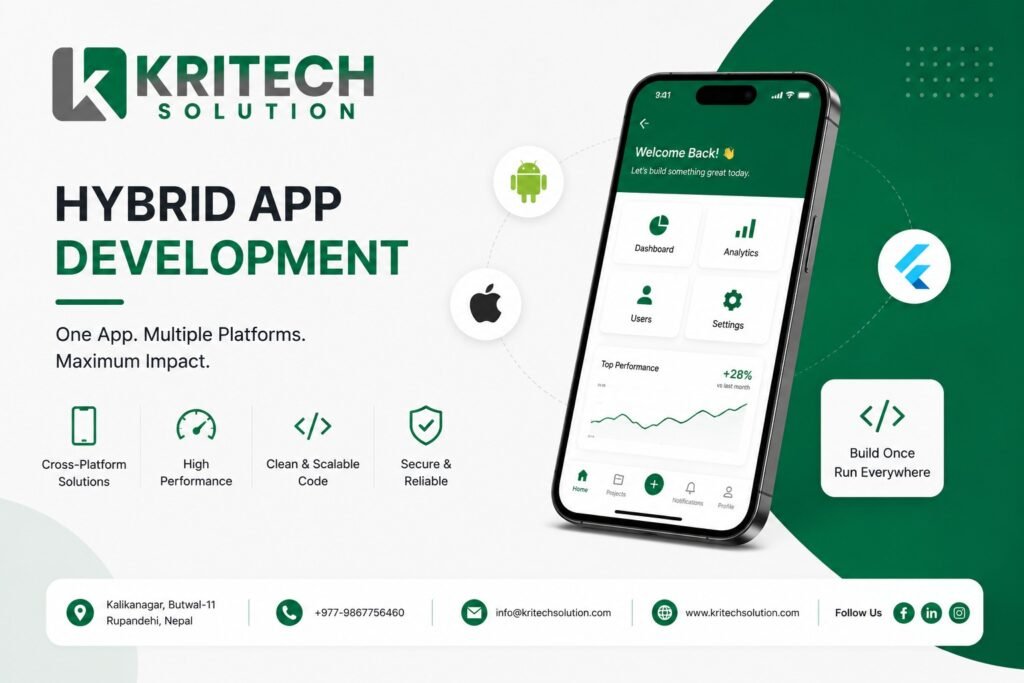
If you have been sitting on the fence about building a mobile app, hybrid app development might just be the answer you have been looking for. Businesses across Nepal and around the world are waking up to a simple truth: you do not need to build separate apps for Android and iOS to succeed. One smart, well-built hybrid app can do it all.
The global mobile app market is expected to generate over $935 billion in revenue by 2023, according to Statista, and that number keeps climbing. Getting your business onto mobile platforms has never been more urgent. The question is not whether to build an app. It is how to build one without blowing your entire budget.
What Is Hybrid App Development and Why Does It Matter?
Hybrid app development is the process of building a single mobile application that runs on both Android and iOS using one shared codebase. Think of it as writing your story once and publishing it in every language at the same time.
Unlike native apps that require completely separate development teams and codebases for each platform, hybrid apps use web technologies like HTML, CSS, JavaScript, and frameworks like Flutter or React Native. The result is an app that feels native, performs well, and reaches every user regardless of what phone they carry.
For growing businesses, especially startups and SMEs in Nepal, this approach is not just convenient. It is a competitive advantage.
Top Benefits of Hybrid App Development for Modern Businesses
Codebase, Two Platforms
The biggest win with hybrid app development is simple: you build once, and you deploy everywhere. Your development team writes the code one time and pushes it to both the Google Play Store and Apple App Store simultaneously.
This cuts your development timeline almost in half. It also means bug fixes, updates, and new features roll out to all users at the same time. No more waiting weeks for one platform to catch up with the other.
Significantly Lower Development Costs
Budget is always a real concern, especially for businesses that are just starting out. Native app development for both Android and iOS can cost two to three times more than building a single hybrid solution.
With hybrid app development, you are essentially paying for one project instead of two. The savings on developer hours, testing cycles, and ongoing maintenance add up fast. For businesses in Nepal looking to maximize every rupee, this matters enormously.
Faster Time to Market
Speed is everything in today's digital market. Every week your app sits in development is a week your competitors are already capturing your potential customers.
Hybrid frameworks like Flutter and React Native have mature ecosystems with thousands of ready-made components and plugins. Your team can move faster, iterate quicker, and launch sooner. According to HubSpot, companies that launch faster consistently outperform slower competitors in user acquisition and early revenue growth.
Hybrid App Development vs Native App Development
Let's be honest. Native apps do have advantages in specific scenarios, particularly for apps that demand extremely high performance like 3D gaming or real-time video processing. But for the vast majority of business applications, the differences are minimal.
Modern hybrid frameworks have closed the performance gap dramatically. Apps built with Flutter, for instance, compile directly to native machine code. Users cannot tell the difference. What they do notice is whether your app is available on their phone, loads quickly, and works without crashing.
For most business use cases including ecommerce platforms, service booking apps, customer portals, and delivery tracking systems, hybrid app development delivers everything a native app can at a fraction of the cost.
Best Hybrid App Development Frameworks to Know in 2025
Not all hybrid frameworks are created equal. Choosing the right one depends on your project requirements, your team's skill set, and your long-term goals.
Flutter by Google has become the go-to choice for teams that want near-native performance and a visually rich UI. Its widget-based architecture gives developers extraordinary creative control.
React Native by Meta remains hugely popular, especially for teams already comfortable with JavaScript. It has a massive community, excellent documentation, and a proven track record across thousands of live apps worldwide.
Ionic is another strong option for web developers who want to transition into mobile app development with minimal friction. It integrates beautifully with Angular, React, and Vue.
Each of these frameworks is actively maintained, widely trusted, and capable of powering serious commercial applications. The Google Developers documentation offers deep technical guidance for teams evaluating Flutter for their next project.
Nepal's digital economy is growing at a remarkable pace. More Nepali consumers are shopping, booking services, and managing finances through mobile apps than ever before. Businesses that have not gone mobile yet are already falling behind.
The challenge for most Nepali businesses is not ambition. It is resources. Hiring two separate development teams for Android and iOS is simply not realistic for most companies outside of Kathmandu's largest enterprises.
Hybrid app development solves that problem completely. A single skilled team can deliver a polished, production-ready app that works on every Android and iOS device in the country. At Kritech Solution, we have helped businesses across Nepal build hybrid apps that are fast, reliable, and built for real growth.
Common Use Cases Where Hybrid Apps Excel
Hybrid app development is not a compromise. For many types of projects, it is genuinely the best possible choice. Here are the use cases where hybrid apps truly shine.
Ecommerce and retail apps benefit massively from hybrid development. Your product catalog, cart, and payment flow look and feel identical across Android and iOS, which creates a consistent customer experience that builds trust.
Service booking platforms for restaurants, salons, clinics, and logistics companies are perfect hybrid app candidates. These apps need reliable performance and a clean UI, both of which hybrid frameworks deliver effortlessly.
Enterprise internal tools like employee dashboards, inventory management systems, and CRM apps are another natural fit. These apps do not need cutting-edge graphics. They need to work reliably, load fast, and stay easy to update.
Content and media apps including news platforms, educational tools, and streaming services also perform extremely well in hybrid environments.
What to Look for in a Hybrid App Development Partner
Choosing the right development partner is just as important as choosing the right framework. A bad technical partner can turn even the best app idea into a frustrating, expensive nightmare.
Look for a team with a real portfolio of live apps. Ask to see examples of their hybrid app work on both Android and iOS devices. Good teams are transparent about timelines, costs, and technical limitations from day one.
Communication matters more than most clients expect. You want a partner who asks smart questions, listens carefully, and gives honest answers rather than just telling you what you want to hear.
Experience with frameworks like Flutter and React Native is non-negotiable. So is a clear understanding of app store submission requirements, performance optimization, and post-launch support.
Frequently Asked Questions About Hybrid App Development
Q1: What is hybrid app development?
Hybrid app development is a method of building mobile applications using a single shared codebase that works across both Android and iOS platforms. It combines web technologies with native device capabilities to deliver a seamless mobile experience without requiring two separate development projects.
Q2: Is hybrid app development cheaper than native?
Yes, significantly. Because you are maintaining one codebase instead of two, development costs, testing time, and ongoing maintenance expenses are all lower. Most businesses save between 30% and 50% compared to building separate native apps for each platform.
Q3: Are hybrid apps slower than native apps?
Modern hybrid frameworks like Flutter compile directly to native code, which means performance is very close to native in most real-world use cases. For standard business applications, users will not notice any meaningful difference in speed or responsiveness.
Q4: Which framework is best for hybrid app development in 2025?
Flutter and React Native are the two leading frameworks in 2025. Flutter is preferred for highly visual, design-driven apps, while React Native is a strong choice for JavaScript-heavy teams and apps that need deep integration with third-party services.
Q5: How long does it take to build a hybrid app?
A simple hybrid app with core features can be built in 6 to 12 weeks. More complex apps with custom integrations, advanced UI, and backend systems typically take 3 to 6 months. Timeline depends heavily on the scope, the team's experience, and how clear the requirements are from the start.
Ready to Build Your App? Let's Make It Happen.
You have got a great idea. Your customers are on mobile. The technology is ready and more affordable than ever. The only thing missing is the right team to bring it all together.
At Kritech Solution, we specialize in hybrid app development that is built for performance, designed for your users, and delivered on time. Whether you are launching your first app or rebuilding an outdated one, we are ready to help you move fast and build smart.
Stop waiting for the perfect moment. Reach out today and let's turn your app idea into a product your customers will love.
Contact Information
Kritech Solution
📍 Butwal-11, Kalikanagar
📞 9867756460
📧 info@kritechsolution.com
🌐 www.kritechsolution.com