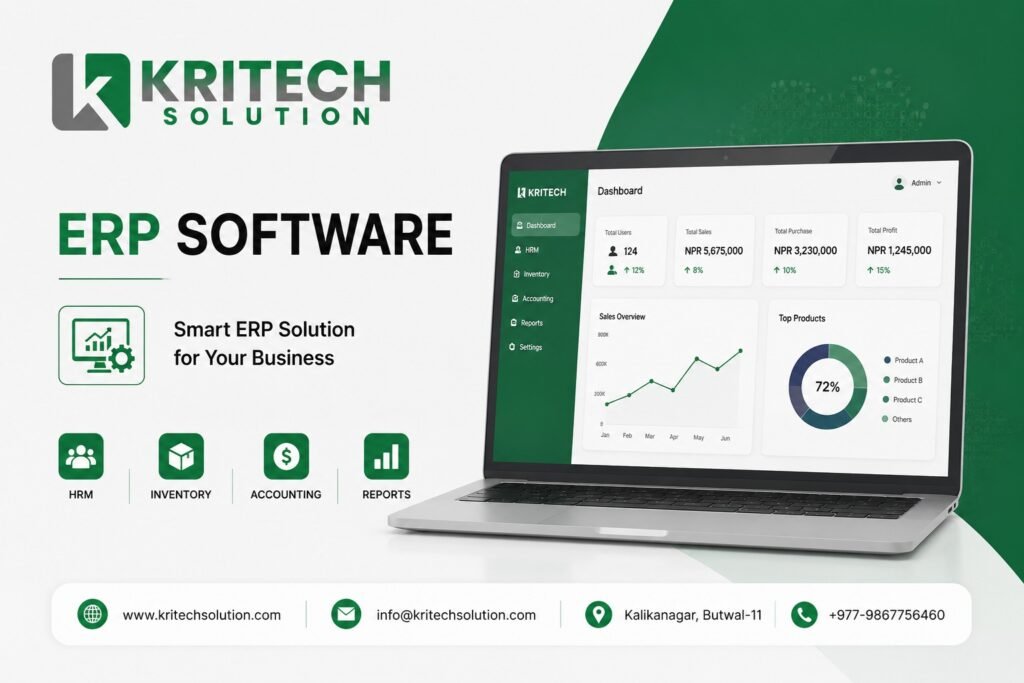
If your business is still running on spreadsheets and disconnected tools, ERP software might just be the single most powerful investment you make this year.
Managing a growing business without a unified system feels like trying to run a marathon in flip-flops. Sales, inventory, HR, accounting, all pulling in different directions. The result? Wasted hours, costly mistakes, and teams that never seem to be on the same page.
That is exactly why smart businesses across Nepal and beyond are turning to ERP software to bring everything together under one roof.
What Is ERP Software and Why Does It Matter?
ERP stands for Enterprise Resource Planning. At its core, ERP software is a centralized platform that connects all your key business functions into a single, integrated system.
Think of it as the nervous system of your company. When one department updates a record, every other connected department sees it in real time. No more data silos, no more chasing people for updates, and no more decisions made on outdated information.
According to Panorama Consulting's ERP research, over 95% of businesses report measurable improvements after implementing an ERP system. That is not a small number.
How ERP Software Transforms Day-to-Day Business Operations
Connecting Your Teams Without the Chaos
One of the biggest wins with ERP software is how it eliminates communication gaps between departments. Finance sees what operations is spending. Sales knows exactly what inventory is available. HR tracks workforce capacity without sending a single email.
This kind of real-time visibility changes how decisions get made. Managers stop guessing and start acting on actual data.
Automating the Work That Drains Your Time
Repetitive manual tasks like data entry, report generation, and invoice processing eat up hours every single week. A well-configured ERP system automates all of that in the background.
Your team gets to focus on higher-value work instead of copy-pasting numbers between spreadsheets. The efficiency gains alone often justify the investment within the first year of deployment.
Top Features to Look For in an ERP Software Solution
Not all ERP systems are built equal. When evaluating your options, here are the capabilities that genuinely move the needle for growing businesses.
Real-Time Reporting and Analytics gives leadership a live view of performance across every department. You can spot problems before they become crises and capitalize on opportunities faster.
Inventory and Supply Chain Management keeps your stock levels accurate, reduces waste, and prevents the nightmare scenario of overselling what you do not have.
Financial Management and Accounting automates your ledgers, handles multi-currency transactions, and keeps your books audit-ready at all times.
Human Resource Management tracks employee records, payroll, attendance, and compliance all in one place. No more juggling three different HR tools.
Customer Relationship Management (CRM) Integration links your sales pipeline directly to your operations, so your sales team always has the full picture when talking to clients.
According to Gartner's enterprise software analysis, cloud-based ERP adoption grew by more than 40% among mid-sized businesses in recent years, driven largely by the flexibility and lower upfront costs these platforms offer.
Cloud ERP Software vs On-Premise: Which One Is Right for You?
This is one of the most common questions businesses ask when they start exploring ERP options. The honest answer is that it depends on your specific needs, team size, and IT infrastructure.
Cloud ERP software is hosted on remote servers and accessed through a browser or app. It requires minimal hardware investment, scales easily as your business grows, and your vendor handles all updates and security patches.
On-premise ERP is installed directly on your own servers. It gives you complete control over your data and can be deeply customized, but it also demands a larger upfront investment and a capable internal IT team to maintain it.
For most small to mid-sized businesses in Nepal, cloud ERP is the faster, more cost-effective path to getting started. You get enterprise-grade capabilities without the enterprise-grade infrastructure burden.
Common Mistakes Businesses Make When Choosing ERP Software
Choosing the wrong ERP system is an expensive mistake that can set a business back by months. Here are the pitfalls that trip up the most companies.
Buying based on price alone is the most common error. A cheaper system that does not fit your workflows will cost you far more in lost productivity and workaround headaches down the road.
Skipping the implementation planning phase is another big one. ERP rollouts fail not because the software is bad, but because teams were not properly trained and change management was ignored. HubSpot's research on digital transformation consistently shows that people and process readiness matter as much as technology.
Trying to replace a system without cleaning your data first also creates serious problems. Migrating messy, duplicated, or outdated records into a new ERP just transfers your old chaos into a shiny new environment.
Why Nepal Businesses Are Adopting ERP Software Faster Than Ever
The business landscape in Nepal is evolving rapidly. Companies in Butwal, Kathmandu, Pokhara, and beyond are facing new competitive pressures, tighter margins, and customers who expect faster service and greater transparency.
ERP software is no longer a luxury reserved for large corporations. Affordable, cloud-based solutions have made it accessible to businesses with as few as 10 to 15 employees. The digital transformation wave is real, and companies that move early gain a compounding advantage over those who wait.
Local implementation partners who understand Nepal's regulatory environment, tax structures, and business culture add enormous value to any ERP deployment. That local context is something a global vendor alone simply cannot provide.
How Kritech Solution Helps You Implement ERP Software Successfully
At Kritech Solution, we do not just sell software. We become the implementation partner that walks with you from day one through to full adoption.
Our team assesses your existing workflows, identifies integration points, configures the system to match your actual processes, and trains your team until they feel genuinely confident using it. We have helped businesses in Butwal and across Nepal go from manual chaos to streamlined, data-driven operations.
We understand that every business is different. That is why we do not push a one-size-fits-all solution. Instead, we match you with the ERP platform that fits your industry, your team size, and your growth ambitions.
Frequently Asked Questions About ERP Software
What is ERP software used for?
ERP software is used to integrate and manage core business processes including finance, human resources, inventory, supply chain, and customer management within a single unified system. It replaces disconnected tools and manual processes with automated, real-time workflows.
How much does ERP software cost?
The cost of ERP software varies widely depending on the platform, number of users, and deployment model. Cloud-based ERP solutions typically range from a monthly subscription fee per user, while on-premise systems involve a larger one-time licensing and infrastructure investment. Getting a customized quote from a local partner like Kritech Solution helps you understand the true total cost of ownership.
How long does ERP implementation take?
A typical ERP implementation for a small to mid-sized business takes anywhere from 3 to 6 months, depending on the complexity of your operations, the amount of data being migrated, and how prepared your team is for the transition.
Can small businesses in Nepal benefit from ERP software?
Absolutely. Modern cloud-based ERP platforms are specifically designed to be scalable and affordable for small businesses. If you have multiple departments, growing transaction volumes, or pain points around visibility and reporting, ERP software will deliver real and measurable value.
What is the difference between ERP and accounting software?
Accounting software focuses only on financial transactions and reporting. ERP software goes several layers deeper, connecting finance with operations, HR, sales, inventory, and more into a single integrated platform. It gives you a complete operational picture, not just a financial one.
Ready to Transform Your Business With the Right ERP Software?
The gap between businesses that grow smoothly and those that stay stuck is often not effort. It is systems. The right ERP software, implemented with the right partner, turns operational confusion into clarity and gives your team the tools to work smarter every single day.
If you are ready to explore what ERP can do for your business, Kritech Solution is here to guide you through every step of the journey. Reach out today and let us show you what is possible.
Contact Information
Kritech Solution
📍 Butwal-11, Kalikanagar
📞 9867756460
📧 info@kritechsolution.com
🌐 www.kritechsolution.com