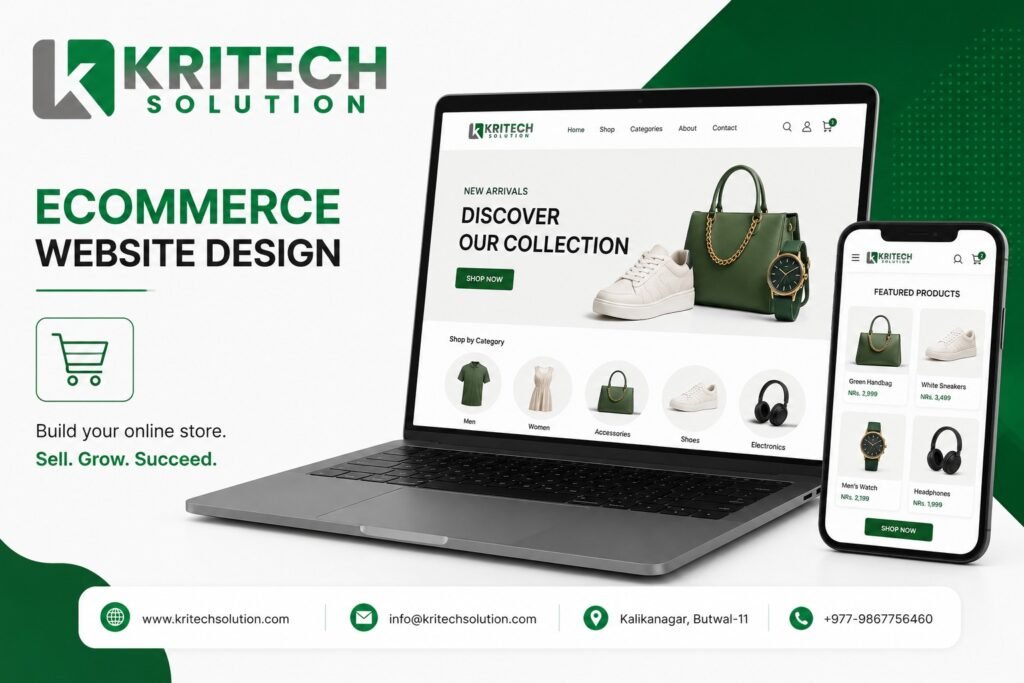
Your ecommerce website design is either making you money while you sleep or quietly costing you sales every single hour of the day.
That is not an exaggeration. In the world of online retail, your website is your storefront, your salesperson, your customer service desk, and your brand ambassador all rolled into one. When it is designed well, customers browse confidently, trust builds naturally, and purchases happen smoothly. When it is designed poorly, visitors hesitate, doubts creep in, and people abandon their carts before you ever had a real chance to serve them.
The difference between an ecommerce website that struggles and one that consistently generates revenue often has nothing to do with the quality of the products being sold. It comes down entirely to how the website is designed, how it makes customers feel, and how effortlessly it guides them from first click to completed purchase.
What Is Ecommerce Website Design and Why Does It Determine Your Online Success?
Ecommerce website design is the strategic process of creating an online store that combines visual appeal, intuitive navigation, persuasive content, technical performance, and conversion-focused user experience into a single cohesive digital environment where customers feel confident buying.
It is far more than choosing colors and arranging product images attractively. Great ecommerce design is rooted in a deep understanding of customer psychology, purchasing behavior, trust signals, and the specific friction points that cause visitors to abandon their buying journey before completing a purchase.
According to Forrester Research, a well-designed user interface can increase conversion rates by up to 200%, and a better overall user experience can push conversion improvements as high as 400%. For an ecommerce business, that kind of performance difference is the gap between surviving and thriving in an increasingly competitive online marketplace.
For businesses in Nepal building or rebuilding their online stores, understanding what separates a high-converting ecommerce design from a mediocre one is the foundation of every smart investment in digital commerce.
The Psychology Behind High-Converting Ecommerce Design
Before diving into specific design strategies, it helps to understand the psychological principles that make ecommerce website design either work powerfully or fail quietly. Every design decision, from the size of your call-to-action buttons to the way product images are presented, influences how customers feel about your store and how confident they feel making a purchase.
Trust is the currency of ecommerce. Customers cannot physically touch your products, speak to a salesperson face to face, or walk out of a store with immediate gratification. Everything your ecommerce website design communicates must compensate for that distance and replace it with digital signals that feel credible, professional, and genuinely reassuring.
Clarity, speed, visual hierarchy, social proof, and frictionless checkout are not design preferences. They are conversion science. The most successful ecommerce websites in the world are designed around these psychological principles first and aesthetic preferences second.
7 Powerful Ecommerce Website Design Secrets That Turn Visitors Into Buyers
1. Design for Mobile Commerce From the Very First Pixel
Mobile commerce is not the future of ecommerce. It is the present, and it has been for several years now. According to Statista, mobile devices account for more than 70% of all ecommerce traffic globally, and that figure continues to climb year over year as smartphone usage deepens across every market including Nepal.
Designing for mobile first means building your ecommerce experience around the smallest screen and the most constrained interaction model, then expanding upward to tablet and desktop. This approach ensures your most common customer experience is your best customer experience. Thumb-friendly navigation, large tap targets, streamlined checkout flows, and fast loading times on mobile networks are not enhancements. They are the foundation of any ecommerce website design that converts in the real world.
2. Build Trust Instantly With Professional Visual Design
A visitor forms a first impression of your ecommerce store in approximately 50 milliseconds, a fraction of a second before they have read a single word or examined a single product. That snap judgment is made entirely on visual design quality, and it determines whether they stay to explore or leave immediately.
Professional ecommerce website design communicates trust through consistent brand identity, high quality product photography, clean and uncluttered layouts, and a visual polish that signals your business takes quality seriously. Trust badges, security seals, clear return policies, and prominently displayed contact information reinforce that initial impression throughout the browsing experience. Every visual element either builds confidence or erodes it. There is no neutral ground in ecommerce design.
3. Create Intuitive Navigation That Leads Customers to Products Effortlessly
The moment a customer has to think hard about how to find what they are looking for, you have already started losing them. Navigation in ecommerce website design is not just a usability feature. It is a direct revenue driver that determines how many of your visitors actually find and engage with the products they came to buy.
Effective ecommerce navigation includes a logical category structure that reflects how customers think about products rather than how your internal systems organize them, a powerful search function with autocomplete and typo tolerance for customers who know exactly what they want, clear filtering and sorting options that help customers narrow large catalogs efficiently, and persistent navigation elements that keep orientation easy regardless of how deep into your catalog a customer browses.
4. Optimize Product Pages to Do the Selling for You
Your product page is where the purchase decision is made. Every element on that page either moves a customer closer to adding to cart or gives them a reason to hesitate. Ecommerce website design at the product page level is where the difference between a good store and a great store becomes most visible.
High-converting product pages combine multiple large, high-quality images showing the product from every relevant angle with the option to zoom, compelling product descriptions that address both features and the emotional benefits customers actually care about, clear and prominent pricing with any savings or urgency signals displayed naturally, social proof through customer reviews and ratings placed close to the purchase action, and a bold, unambiguous call-to-action that makes adding to cart feel like the obvious and easy next step.
5. Eliminate Friction From Every Step of the Checkout Process
Cart abandonment is the single most painful metric in ecommerce, and checkout friction is its primary cause. According to HubSpot, the average ecommerce cart abandonment rate sits above 70%, meaning the majority of customers who intend to buy never complete their purchase. The checkout experience your ecommerce website design delivers determines how much of that lost revenue you recover.
Reducing checkout friction means offering guest checkout so customers never have to create an account to complete a purchase, minimizing the number of form fields to only what is genuinely necessary, displaying multiple trusted payment options including local payment methods relevant to your market, showing a clear progress indicator so customers always know how close they are to completing their order, and providing immediate, prominent reassurance about security, privacy, and returns at every stage of the checkout flow.
6. Use Social Proof Strategically Throughout the Design
Humans are wired to look to others for validation before making decisions, especially in situations that involve spending money on something they cannot physically evaluate. Ecommerce website design that strategically integrates social proof at every stage of the customer journey consistently converts better than design that relies on product descriptions and brand claims alone.
Social proof in ecommerce takes many forms. Customer reviews and star ratings on product pages are the most fundamental and most impactful. User-generated photos showing real customers using real products build authenticity that professional photography cannot replicate. Trust statistics such as the number of customers served or orders fulfilled add credibility at scale. Recently purchased notifications, wish list counts, and low stock indicators leverage social and scarcity signals that motivate purchasing decisions in ways that feel natural and genuinely helpful rather than manipulative.
7. Optimize Site Speed as a Core Design Requirement
Page speed is not a technical consideration separate from design. It is a design requirement that belongs at the center of every ecommerce website design decision from the very beginning. A beautifully designed ecommerce store that loads slowly is a store that loses customers before they ever see what it has to offer.
Research from Google confirms that for every one-second delay in mobile page load time, conversion rates drop by up to 20%. For an ecommerce business processing meaningful transaction volumes, that performance gap translates directly into significant lost revenue every single day. Image optimization, efficient code, content delivery networks, and server performance are all design decisions that belong in every ecommerce project brief alongside color palettes and typography choices.
The Ecommerce Design Elements That Build Long-Term Customer Loyalty
Acquiring a new customer costs significantly more than retaining an existing one, which means ecommerce website design decisions that encourage repeat purchasing are among the highest-return investments in your entire digital strategy.
Post-purchase experience design, including order confirmation pages, shipping notification emails, and return processes, shapes how customers feel about your brand long after the transaction is complete. Personalization features that surface relevant products based on browsing and purchase history make returning customers feel understood and valued. Loyalty program integration and account features that make reordering effortless transform one-time buyers into brand advocates.
At Kritech Solution, ecommerce website design is approached as a complete customer experience strategy rather than a single project with a launch date. The goal is always to build online stores that not only convert visitors on their first visit but create the kind of experience that brings them back again and again.
Ecommerce Website Design in Nepal: Capturing a Market in Rapid Growth
Nepal's ecommerce market is at an inflection point. Growing internet penetration, accelerating smartphone adoption, increasing consumer comfort with online purchasing, and expanding digital payment infrastructure are converging to create an ecommerce opportunity that did not exist at this scale just a few years ago.
Businesses that invest in high-quality ecommerce website design now are positioning themselves to capture significant market share as this growth continues to accelerate. The competitive advantage of a well-designed, fast, trustworthy online store in Nepal's current market is substantial, because the bar set by the majority of existing ecommerce sites leaves enormous room for businesses that take design and user experience seriously to stand out immediately.
The consumers driving Nepal's ecommerce growth are sophisticated, mobile-first, and increasingly experienced online shoppers who recognize quality and trust when they encounter it. Meeting that expectation with professional ecommerce design is not just good business practice. It is the entry requirement for competing effectively in Nepal's digital marketplace.
Choosing the Right Ecommerce Platform for Your Design Goals
The platform your ecommerce store is built on has a significant impact on what your design can achieve and how effectively it can be implemented. Different platforms offer different levels of design flexibility, performance capability, and scalability, and the right choice depends entirely on your specific business requirements, product catalog complexity, and growth ambitions.
WooCommerce built on WordPress offers exceptional design flexibility and is well-suited to businesses that want full control over their store's appearance and functionality without the constraints of a proprietary platform. Shopify provides a fast, reliable hosted solution with a strong ecosystem of design themes and apps that suits businesses prioritizing speed of launch and ease of management. Custom-built ecommerce solutions deliver the highest level of design and functionality customization for businesses with complex requirements that no off-the-shelf platform can adequately serve.
The decision should always start with your business requirements and customer experience goals rather than platform familiarity or cost alone. An ecommerce platform that limits your design vision or cannot scale with your growth is always the most expensive choice in the long run, regardless of how affordable it seemed at the outset.
Frequently Asked Questions About Ecommerce Website Design
Q: How much does ecommerce website design cost in Nepal?
Ecommerce website design costs in Nepal vary considerably based on the scope, complexity, platform choice, and level of customization required. A professionally designed WooCommerce or Shopify store for a small to medium business typically ranges from NPR 50,000 to NPR 200,000 or more depending on the number of products, required integrations, and custom functionality. Fully custom ecommerce solutions with complex functionality requirements represent a higher investment that is best discussed directly with a development team after a thorough requirements discovery process.
Q: How long does it take to design and launch an ecommerce website design?
A professionally designed ecommerce website typically takes four to ten weeks from project kickoff to launch depending on the platform, number of products, custom functionality requirements, and how quickly content and feedback are provided during the design process. Custom ecommerce solutions with complex integrations or unique functionality may take twelve to twenty weeks. Rushing the design and development process to meet an arbitrary deadline consistently produces inferior results that cost more to fix later than the time saved at launch.
Q: What is the most important element of ecommerce website design for conversions? Trust signals and checkout experience consistently have the greatest direct impact on ecommerce conversion rates. A customer who does not trust your store will not buy regardless of how good your products are or how attractive your design is. Beyond trust, a frictionless checkout process that removes every unnecessary barrier between the add to cart action and the completed purchase is the single highest-impact conversion optimization in any ecommerce design. Both elements work together and neither can compensate for a serious weakness in the other.
Q: Should I use a template or get a custom ecommerce website design?
Templates offer a faster and more affordable starting point but come with significant design and functionality limitations that become increasingly constraining as your business grows. Custom ecommerce website design delivers a unique brand experience, optimized specifically for your customers and products, with the flexibility to implement exactly the features and integrations your business needs. For businesses serious about building a strong, scalable online store, custom design almost always delivers superior long-term returns compared to template-based approaches.
Q: How do I make my ecommerce website rank on Google?
Ecommerce SEO is a comprehensive discipline that combines technical SEO foundations, on-page optimization of product and category pages, content marketing through blogs and buying guides, and off-page authority building through backlinks and brand mentions. The design of your ecommerce website plays a direct role in SEO performance through page speed, mobile responsiveness, structured data implementation, URL architecture, and internal linking strategy. Building SEO requirements into your ecommerce design from the beginning is always more effective and efficient than attempting to retrofit SEO onto a site that was not designed with search visibility in mind.
Ready to Build an Ecommerce Website Designs That Works as Hard as You Do?
Your products deserve an online store that presents them beautifully, earns customer trust instantly, and guides every visitor effortlessly toward completing a purchase. A mediocre ecommerce website does not just underperform. It actively undermines the quality of what you are selling by failing to communicate it effectively to the customers who are already looking for it.
The right ecommerce website design is one of the highest-return investments any product-based business can make. It works for you around the clock, in every market, reaching every customer who finds you online and giving them every reason to buy with confidence.
Kritech Solution brings together design expertise, technical excellence, and a deep understanding of conversion psychology to build ecommerce website designs that do not just look impressive but genuinely perform. Reach out today and let us build the online store your products and your customers deserve.
Contact Information
Kritech Solution
📍 Butwal-11, Kalikanagar
📞 9867756460
📧 info@kritechsolution.com
🌐 www.kritechsolution.com