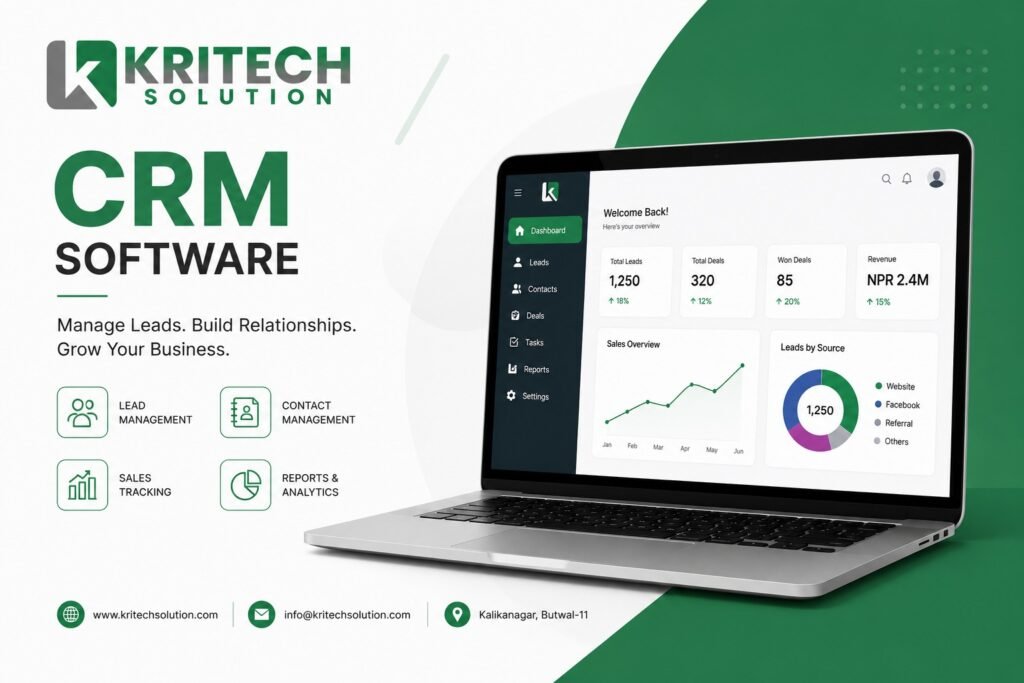
What if you could remember every conversation you ever had with every customer, know exactly where each deal stands, and never let a follow-up slip through the cracks again? That is not a fantasy. That is what the right CRM software does for your business every single day.
Customer relationship management is no longer a luxury reserved for large enterprises. In 2025, it is the operational backbone of every serious, growth-focused business regardless of size, industry, or location. At Kritech Solution, we help businesses across Nepal implement and customize CRM software that does not just organize data. It drives real, measurable revenue growth. This guide covers everything you need to know.
What Is CRM Software and Why Does Every Business Need It?
CRM software is a centralized platform that helps businesses manage every interaction with their customers and prospects. It stores contact information, tracks communication history, manages sales pipelines, automates follow-ups, and generates insights that help you make smarter decisions about where to focus your energy.
Think of it as the brain of your entire customer-facing operation. Without it, your sales team is working from scattered spreadsheets, your marketing team does not know which leads converted, and your customer service team has no context when someone calls with a problem. With it, every team member has a complete, real-time picture of every customer relationship.
A significant 91% of companies with 10 or more employees now use CRM software, making it essentially standard operational infrastructure for established businesses. If your competitors are running CRM software and you are not, you are already operating at a measurable disadvantage. And in a competitive market like Nepal's growing digital economy, that gap matters more every year.
The Business Case for CRM Software: The Numbers Are Undeniable
Numbers do not lie, and when it comes to CRM software, the data makes a compelling case for adoption that is almost impossible to argue with. The returns businesses see from properly implemented CRM solutions are consistent, significant, and documented across thousands of companies worldwide.
Businesses using CRM software see a 29% increase in sales, a 34% improvement in sales productivity, and a 42% increase in sales forecast accuracy. Those are not incremental improvements. Those are transformative gains that fundamentally change how a sales team operates and what it can achieve.
On average, businesses can expect an ROI of 8.71 dollars for every dollar spent on CRM software. When properly implemented, the ROI of CRM can increase by as much as 245%. The question is not whether you can afford CRM software. The question is whether you can afford to keep operating without it.
CRM Software and Customer Retention: A Direct Connection
Acquiring a new customer costs significantly more than retaining an existing one. Every business owner knows this in theory. CRM software makes it actionable in practice by giving you the tools to nurture existing relationships with the consistency and personalization that builds genuine loyalty.
According to Aberdeen Group, companies that effectively use CRM tools to engage with customers experience a 27% increase in customer retention rates. And according to Forrester, 75% of organizations using CRM software have seen a significant improvement in customer satisfaction metrics. Better retention and higher satisfaction mean more repeat revenue, more referrals, and a customer base that grows stronger over time.
10 CRM Software Benefits That Directly Impact Your Revenue
1. Every Customer Interaction in One Place
Before CRM software, customer information lived in email inboxes, notebook pages, spreadsheets, and the memories of individual team members. When that team member left, the knowledge walked out the door with them. CRM software ends that vulnerability permanently.
Every call, every email, every meeting note, every purchase history, and every support interaction is recorded and accessible to every authorized team member in seconds. That institutional memory is one of the most valuable assets a business can build. It creates continuity, consistency, and a level of customer understanding that feels genuinely impressive from the customer's perspective.
2. A Sales Pipeline You Can Actually See and Manage
Without visibility into your sales pipeline, you are flying blind. You do not know which deals are progressing, which ones are stalling, which prospects need a follow-up today, or where your revenue for next month is likely to come from.
CRM software gives you a clear, visual pipeline that shows every deal at every stage. Your sales team knows exactly what actions to take and when. Your management team can spot bottlenecks and intervene before deals are lost. And your forecasting becomes based on data rather than guesswork, which makes planning dramatically more reliable.
3. Automated Follow-Ups That Never Drop the Ball
One of the most common and costly sales failures is the dropped follow-up. A prospect shows interest, a salesperson gets busy, and by the time anyone reaches back out, the opportunity has gone cold or moved to a competitor. CRM software eliminates this problem at the system level.
Automated reminders, task scheduling, email sequences, and follow-up triggers ensure that no prospect falls through the cracks regardless of how busy your team gets. Sales teams implementing a CRM system can experience an increase in lead conversion rates of up to 300%. That kind of uplift is largely driven by the simple but powerful discipline of consistent, timely follow-up that CRM software makes effortless.
4. Personalization at Scale That Customers Actually Notice
Modern customers expect to be treated as individuals, not as entries in a contact list. They notice when a business remembers their preferences, references their history, and communicates in a way that feels genuinely relevant to their situation. CRM software makes that level of personalization achievable even as your customer base grows.
Personalized email campaigns based on CRM data show a 14% higher click-through rate compared to non-personalized campaigns, according to Statista. When you use CRM software to segment your audience, tailor your messaging, and time your outreach around each customer's specific journey, your communication feels like a conversation rather than a broadcast. That difference is felt, remembered, and rewarded with loyalty.
5. Dramatically Better Team Collaboration
When customer information is scattered across individual inboxes and spreadsheets, collaboration is almost impossible. Sales does not know what marketing promised. Support does not know what sales committed. Everyone is working with incomplete information and the customer pays the price with a fragmented, inconsistent experience.
CRM software creates a single source of truth that every team can work from simultaneously. Sales, marketing, customer service, and management all see the same data in real time. Handoffs become seamless. Context is never lost. And the customer experience becomes consistent regardless of who they are talking to or which channel they are using.
6. Smarter Marketing That Reaches the Right People
CRM software is not just a sales tool. It is one of the most powerful assets your marketing team can access. The customer data stored in your CRM reveals patterns, preferences, and behaviors that transform how you plan and execute marketing campaigns.
You can segment your audience based on purchase history, engagement level, location, industry, or any other attribute you track. You can identify which lead sources produce your most valuable customers and invest more in those channels. And you can measure the actual revenue impact of every marketing activity by connecting campaign data directly to customer outcomes.
7. Faster, More Informed Customer Service
When a customer contacts your support team, the last thing they want to do is explain their history with your business from scratch. CRM software eliminates that frustration by giving your support team instant access to everything they need to provide knowledgeable, efficient, and personalized service from the first moment of contact.
Around 47% of businesses using CRM report a significant improvement in customer service efficiency according to Software Advice. Faster resolution times, fewer escalations, and more empathetic service all contribute to the kind of customer experience that generates positive reviews, referrals, and repeat business. Good service is a growth strategy, and CRM software is the tool that makes it scalable.
8. Real-Time Reporting and Actionable Business Intelligence
What gets measured gets managed. CRM software gives you access to a continuous stream of data about your sales activity, pipeline health, conversion rates, customer behavior, team performance, and revenue trends. That visibility changes how you run your business.
Instead of making decisions based on gut feelings or outdated reports, you make them based on real-time data that reflects exactly what is happening right now. You can identify your best-performing sales reps and understand what they are doing differently. You can spot the points in your sales process where deals most often stall. And you can course-correct quickly when something is not working, instead of discovering a problem months after it started.
9. Scalability That Grows With Your Business
The systems that work for a team of five often break down for a team of fifty. CRM software grows with your business in a way that spreadsheets, email threads, and manual processes simply cannot. Whether you double your team, expand to new markets, or add new product lines, your CRM scales to accommodate without requiring a complete overhaul.
65% of businesses implement CRM software within their first five years of operation, recognizing that early adoption is critical for supporting business growth. The businesses that build CRM habits and data assets early are the ones that scale with confidence. The ones that wait until they are overwhelmed often find that retrofitting CRM into an established but chaotic operation is far harder than starting right.
10. Competitive Advantage That Compounds Over Time
Every customer interaction you log, every preference you record, and every pattern you identify becomes part of a growing competitive intelligence asset that is unique to your business. Competitors using generic spreadsheets simply cannot replicate the depth of customer understanding that a well-used CRM software system builds over months and years.
This compounding advantage shows up in better retention, higher conversion rates, more effective marketing, and a customer experience that feels distinctively attentive and personal. It is one of the most durable forms of competitive advantage a business can build because it cannot be easily copied and it keeps getting stronger the longer you use it.
How to Choose the Right CRM Software for Your Business
The CRM software market is vast and varied. From lightweight tools designed for solo operators to enterprise platforms serving thousands of users simultaneously, the options can feel overwhelming. Choosing the right one for your specific situation requires clarity about your needs, your team, and your growth trajectory.
Start by defining what you most need CRM software to solve. Is the primary pain point disorganized contact data? Inconsistent follow-ups? Poor sales pipeline visibility? Disconnected marketing and sales teams? Identifying your core challenge points you toward the features that matter most and helps you avoid paying for capabilities you will never use.
Consider your team's technical comfort level honestly. The most feature-rich CRM in the world delivers zero value if your team finds it too complex to use consistently. Roughly 70% of CRM projects fail to meet their goals, not because of the software itself, but due to cross-functional misalignment and poor adoption. User adoption is everything. A simpler system used religiously outperforms a sophisticated one that half the team avoids.
Cloud-Based vs On-Premise CRM Software
The vast majority of modern CRM implementations are cloud-based, and for good reason. 87% of CRM systems are now cloud-based, rising dramatically from just 12% in 2008, reflecting the widespread adoption of SaaS solutions. Cloud-based CRM software requires no expensive server infrastructure, is accessible from any device anywhere in the world, updates automatically, and scales effortlessly as your business grows. Dialectica
For most businesses in Nepal, cloud-based CRM software is the clear practical choice. It eliminates the need for dedicated IT infrastructure, reduces maintenance burden, and makes remote and mobile access seamless. The monthly subscription model also makes it financially accessible for businesses at every stage, with costs that scale proportionally to the value you receive.
CRM Software Implementation: Getting It Right the First Time
Even the best CRM software delivers mediocre results when implemented poorly. A thoughtful, structured implementation process is what separates businesses that transform their sales and customer management from those that end up with an expensive system that nobody really uses.
Start with data migration. Moving your existing customer and prospect data cleanly into your new CRM software sets the foundation for everything that follows. Dirty data going in means unreliable insights coming out. Take the time to clean, deduplicate, and organize your data before you migrate it.
Invest seriously in training. Every team member who will use the CRM software needs hands-on training that connects the tool's features to their specific daily workflows. Abstract training that does not relate to real tasks produces poor adoption. Show your team exactly how CRM software makes their specific jobs easier, faster, and more effective.
Measuring CRM Software Success
Define success metrics before you go live and track them consistently after. Sales cycle length, lead conversion rate, customer retention rate, average deal size, and revenue per sales rep are all meaningful measures of CRM software impact. Establish baseline numbers before implementation and review progress monthly in the early stages.
Set realistic expectations about timelines. Most businesses start seeing meaningful improvements within the first 60 to 90 days of consistent CRM software use. The full compounding benefits of a well-adopted CRM take six to twelve months to become clearly visible in your business metrics. Patience and consistency in the early stages are what separate businesses that get transformative results from those that abandon the process too early.
AI and the Future of CRM Software
Artificial intelligence is rapidly transforming what CRM software can do, moving it from a system of record to a system of intelligence that proactively guides better decisions.
Over 79% of CRM users recognize the importance of artificial intelligence in CRM sales tools, and 83% of companies now use AI-driven CRM features for automation and personalization. AI capabilities in modern CRM software include predictive lead scoring that identifies your highest-value prospects, sentiment analysis that flags at-risk customer relationships before they churn, and automated data entry that eliminates the administrative burden that makes many salespeople reluctant to use CRM consistently.
The businesses investing in AI-enhanced CRM software today are building a compounding advantage that will be very difficult for slower-moving competitors to close. The gap between businesses using intelligent CRM and those using static spreadsheets is growing wider every quarter.
CRM Software for Nepal Businesses: A Growing Imperative
Nepal's business landscape is evolving rapidly. Customer expectations are rising, digital communication channels are multiplying, and competition is intensifying across virtually every industry. In this environment, the businesses that manage customer relationships most effectively will win.
CRM software is not a solution reserved for large multinational corporations. Small and medium-sized businesses in Nepal stand to gain enormously from the organization, automation, and insight that a well-implemented CRM delivers. Whether you run a travel company in Pokhara, a retail business in Kathmandu, a services firm in Butwal, or an IT company serving clients across the country, CRM software will fundamentally improve how you acquire, serve, and retain customers.
The investment is modest, the learning curve is manageable with the right support, and the returns are both measurable and substantial. The question is not whether you need CRM software. The question is how much longer you can afford to grow without it.
How Kritech Solution Helps You Get the Most From CRM Software
At Kritech Solution, we do not just sell or set up CRM software and walk away. We partner with you through the entire journey, from selecting the right platform for your specific needs to configuring it for your workflows, migrating your data, training your team, and providing ongoing support as your business evolves.
We understand that every business is different. Your sales process, your customer journey, your team structure, and your growth goals are unique to you. That is why we never offer a one-size-fits-all CRM implementation. We take the time to understand your business deeply before we recommend a single solution or write a single configuration.
Our team brings both technical expertise and genuine business understanding to every CRM project. We speak your language, not just the language of software. And we measure our success by the results you achieve, not just by whether the system is technically functional.
Whether you are implementing CRM software for the first time, switching from a system that is not working for you, or looking to get dramatically more value from a CRM you already have, Kritech Solution has the expertise and the commitment to make it happen.
The Direct Answer: What Does CRM Software Actually Do for Your Business?
CRM software centralizes all your customer data, automates routine sales and marketing tasks, gives your team complete visibility into every customer relationship, and generates insights that drive smarter decisions across your entire business. It increases sales, improves productivity, boosts customer retention, and delivers measurable ROI that compounds the longer and more consistently you use it.
Common CRM Software Mistakes to Avoid
Purchasing CRM software without a clear adoption plan is the single most common reason implementations fail. Technology alone does not change behavior. You need buy-in from your team, clear processes built around the CRM, and consistent leadership reinforcement of the habit of using it daily.
Choosing a CRM based on brand recognition rather than fit is another expensive mistake. The most popular platforms are not always the best fit for your specific team size, industry, technical comfort level, or budget. Always evaluate CRM software against your actual requirements, not against a feature list that sounds impressive but does not match how you work.
Finally, treating CRM software as an expense rather than an investment leads to underinvestment in configuration, training, and ongoing optimization. The businesses that get the most from CRM software treat it like a strategic asset and invest accordingly in making it work brilliantly for their specific context.
Frequently Asked Questions About CRM Software
Q1: What is CRM software and who needs it?
CRM software is a platform that helps businesses manage customer relationships, track sales activities, automate follow-ups, and analyze customer data. Any business that manages more than a handful of customer relationships and wants to grow consistently needs CRM software. It is especially valuable for sales teams, marketing teams, and customer service operations of any size.
Q2: How much does CRM software cost for a small business in Nepal?
CRM software costs vary widely depending on the platform, the number of users, and the features required. Cloud-based CRM options start at very accessible price points and scale with your team. Kritech Solution helps businesses evaluate options and find the right fit for their budget and needs, with no upselling of features you do not require.
Q3: How long does it take to implement CRM software?
A basic CRM software implementation for a small team can be completed in one to two weeks. More complex implementations involving data migration, custom workflows, and integrations with other systems typically take four to eight weeks. Kritech Solution manages the entire process and provides training to ensure your team is confident and productive from day one.
Q4: Can CRM software integrate with the other tools we already use?
Most modern cloud-based CRM platforms integrate with a wide range of business tools including email, calendar, accounting software, marketing platforms, and communication tools. Integration ensures your CRM becomes the central hub of your operations rather than another isolated system your team has to maintain separately.
Q5: What is the difference between CRM software and a spreadsheet for managing customers?
CRM software automates administrative tasks, centralizes customer data, and shortens sales cycles through better data accessibility, while providing real-time visibility and reporting that spreadsheets simply cannot match. Spreadsheets are static, error-prone, difficult to share, and offer no automation. CRM software is dynamic, accurate, collaborative, and continuously working to make your team more productive even when they are not actively using it.
Ready to Transform Your Customer Relationships With CRM Software?
Your customers are your most valuable asset. The way you manage those relationships determines how long they stay, how much they spend, and how many new customers they refer to you. Stop managing that asset with tools that were never designed for the job.
Kritech Solution is ready to help you find, implement, and get maximum value from the CRM software that is right for your business. Reach out today and let us show you what is possible when your customer relationships are managed with the intelligence, consistency, and care they deserve.
Contact Information
Kritech Solution
📍 Butwal-11, Kalikanagar
📞 9867756460
📧 info@kritechsolution.com
🌐 www.kritechsolution.com