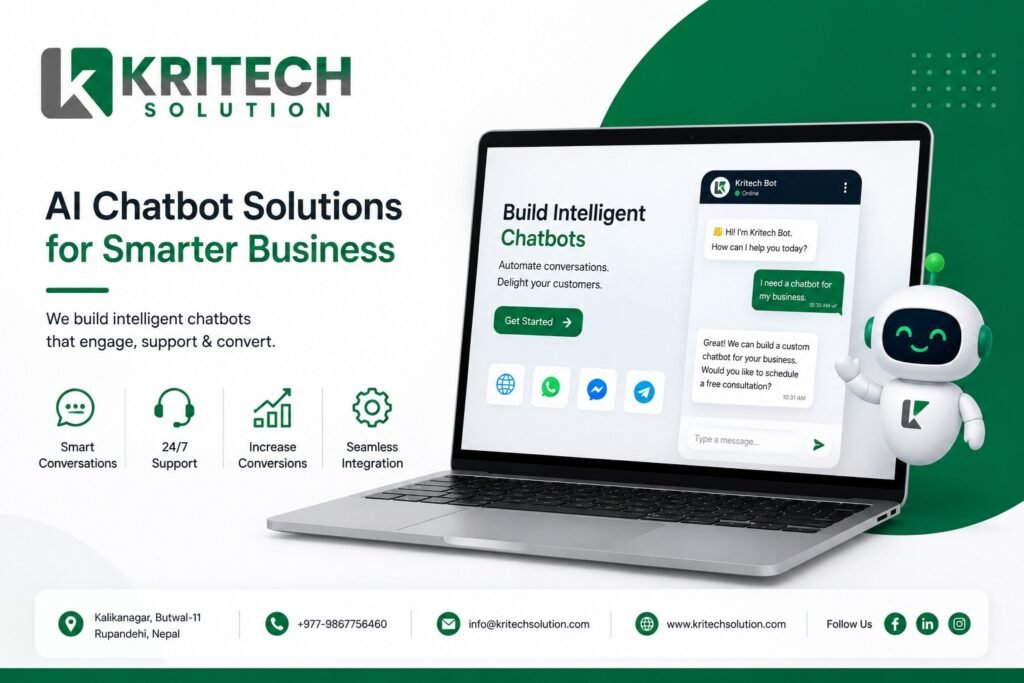
Introduction
Chatbot development is no longer a luxury reserved for tech giants and Fortune 500 companies. Today, businesses of every size are deploying intelligent chatbots that handle customer queries, qualify leads, process orders, and deliver personalized experiences around the clock without a single human agent having to lift a finger. If your business is still relying entirely on phone calls, email threads, and manual responses to manage customer communication, you are working significantly harder than you need to.
The numbers tell a compelling story. According to Statista, the global chatbot market is expected to surpass $27 billion by 2030, growing at a compound annual rate that reflects just how rapidly businesses everywhere are recognizing the operational and revenue advantages of chatbot development and conversational automation. For businesses in Nepal and globally, that growth trajectory represents a real and immediate opportunity to compete smarter, serve better, and scale faster.
This guide covers everything you need to know about chatbot development in 2025, from the types of chatbots and technology choices to implementation strategies and the measurable business outcomes that make the investment genuinely worthwhile.
What Is Chatbot Development and Why Does Your Business Need It Right Now?
Chatbot development is the process of designing, building, and deploying software that simulates human conversation to interact with users through text or voice interfaces. Modern chatbot development ranges from simple rule-based systems that follow predefined decision trees to sophisticated AI-powered conversational agents that understand natural language, learn from interactions, and deliver responses that feel genuinely human.
What makes chatbot development so strategically valuable in 2025 is the intersection of three factors that have never aligned so favorably before. AI and natural language processing technology has matured to the point where building genuinely useful chatbots no longer requires a team of machine learning engineers. Customer expectations for instant, 24/7 responses have risen to the point where businesses that cannot deliver them lose customers to those that can. And the cost of chatbot development has dropped dramatically, making the ROI calculation straightforward for businesses of virtually any size.
For Nepali businesses specifically, chatbot development opens up possibilities that were simply not accessible even three years ago. A small ecommerce business in Butwal can now deploy a chatbot that handles hundreds of simultaneous customer conversations in both Nepali and English, qualifies purchase intent, answers product questions, and routes complex queries to human agents, all on a budget that makes genuine business sense.
Types of Chatbots to Know Before Starting Chatbot Development
Not every chatbot is built the same way or serves the same purpose. Understanding the different types of chatbot development approaches is the first step toward making a smart investment that actually solves the problem you are trying to address.
Rule-based chatbots operate on predefined conversation flows where every possible user input triggers a specific predetermined response. They are straightforward to build, easy to control, and work extremely well for use cases with predictable, limited conversation paths like appointment booking, FAQ responses, order status checks, and simple lead capture forms. The limitation is that they break down quickly when users ask questions outside the defined flow, which can create frustrating experiences if the scope is not carefully managed.
AI-powered chatbot development uses natural language processing and machine learning to understand user intent rather than just matching specific keywords or following rigid scripts. These chatbots handle the unpredictability of real human conversation, learn from past interactions, understand context across a multi-turn conversation, and deliver responses that feel genuinely intelligent rather than scripted. The development complexity and cost are higher, but for businesses with diverse, complex customer communication needs, the investment delivers dramatically better outcomes.
Hybrid chatbot development combines the reliability of rule-based flows for structured tasks with the flexibility of AI for open-ended conversation. This architecture is increasingly the default choice for businesses that need both predictability in critical workflows and the ability to handle the full range of real customer interactions intelligently. Most production-grade chatbot development projects in 2025 use some variation of this hybrid approach.
Chatbot Development for Customer Support: Transforming Service at Scale
Customer support is the most widely adopted use case for chatbot development, and the business case is immediately obvious to anyone who has managed a customer-facing team. Support teams spend enormous amounts of time answering the same questions repeatedly, managing simple requests that do not require human judgment, and handling after-hours inquiries that fall through the cracks until the next business day.
A well-built customer support chatbot handles the full spectrum of routine support interactions instantly, accurately, and consistently at any hour of the day or night. Common questions about pricing, product features, delivery timelines, return policies, and account management are resolved in seconds rather than minutes or hours. Your human support team is freed to focus on the genuinely complex, high-value interactions that actually benefit from human empathy and judgment.
The impact on customer satisfaction is measurable and significant. According to HubSpot's Customer Service Report, 90 percent of customers rate an immediate response as important or very important when they have a support question. Chatbot development is the only scalable way to deliver that immediacy consistently across every customer interaction regardless of volume or time of day.
Escalation design is one of the most critical elements of customer support chatbot development. The chatbot needs to recognize when a conversation has exceeded its capabilities and hand off to a human agent smoothly, with full conversation context transferred so the customer never has to repeat themselves. Getting this handoff right is what separates professional chatbot development from amateur implementations.
Lead Generation Chatbot Development: Turning Visitors Into Qualified Prospects
One of the highest-ROI applications of chatbot development is lead generation, and businesses that have deployed lead gen chatbots consistently report that they outperform traditional static contact forms by a significant margin. The reason is simple: a conversation feels personal and engaging in a way that a blank form field never can.
A lead generation chatbot engages website visitors proactively at the right moment in their browsing journey, asks qualifying questions naturally through conversation, collects contact information without the friction of a formal form, and delivers qualified prospect data directly into your CRM. The entire interaction feels helpful rather than transactional, which dramatically increases the percentage of visitors who engage and complete the process.
Qualification logic is what separates chatbot development that delivers value from projects that just collect email addresses. Smart qualification flows ask the right questions to determine budget, timeline, decision-making authority, and specific need before routing the lead to the appropriate sales response. Your sales team receives prospects who are already screened rather than spending their time calling leads that were never a realistic fit.
Personalization at scale is another powerful advantage of lead generation chatbot development. By connecting your chatbot to your CRM and marketing automation platform, returning visitors can be recognized and greeted with context-aware conversations that reference their previous interactions, their industry, or their specific interests. That level of personalization drives dramatically higher conversion rates than generic, one-size-fits-all chat experiences.
AI-Powered Chatbot Development: What Makes the Real Difference in 2025
The AI capabilities available in chatbot development in 2025 are genuinely extraordinary compared to even two years ago. Large language models, improved natural language understanding, and sophisticated dialogue management systems have raised the ceiling of what conversational AI can deliver to a level that would have seemed unrealistic not long ago.
Integration with large language models like GPT-4 and Claude allows chatbot development teams to build systems that generate contextually appropriate, nuanced responses to an almost unlimited range of user inputs without manually scripting every possible conversation path. This dramatically reduces the development time required while simultaneously raising the quality of the conversational experience delivered.
Sentiment analysis capabilities allow AI chatbots to detect frustration, confusion, or urgency in user messages and adapt their responses accordingly. A user who is clearly frustrated gets a different response tone and faster escalation than a user browsing casually. This emotional intelligence makes AI chatbot development significantly more effective at maintaining positive customer experiences under stress.
Intent recognition has become remarkably accurate in modern chatbot development. According to Forrester Research, businesses deploying AI-powered conversational interfaces report customer satisfaction scores consistently higher than those using rule-based systems alone, validating the investment in more sophisticated AI chatbot development approaches.
Multilingual capability is particularly valuable for businesses in Nepal's diverse linguistic market. Modern AI chatbot development makes it genuinely feasible to deploy a single chatbot that communicates naturally in Nepali, English, and other languages without requiring separate development efforts for each language.
Chatbot Development Platforms: Choosing the Right Technology Stack
Choosing the right platform and technology stack for your chatbot development project depends on your use case complexity, your existing technology infrastructure, your team's technical capabilities, and your budget. The landscape of available tools has expanded dramatically and selecting the right combination requires clear thinking about your actual requirements rather than chasing the most sophisticated solution available.
For businesses that need a relatively straightforward chatbot with defined conversation flows and standard integrations, no-code and low-code platforms like Tidio, Intercom, ManyChat, and Freshchat offer impressive capabilities with minimal chatbot development investment. These platforms handle the infrastructure, provide visual conversation builders, and integrate with common CRM and marketing tools out of the box.
Custom chatbot development becomes the better investment when your requirements include deep integration with proprietary systems, sophisticated AI capabilities beyond what off-the-shelf platforms provide, highly specific conversation logic, or a need for complete control over data privacy and infrastructure. Custom chatbot development takes longer and costs more upfront but delivers a solution tailored precisely to your workflow rather than forcing your workflow to adapt to a generic platform's limitations.
Frameworks like Rasa, Microsoft Bot Framework, and Dialogflow sit between the no-code platforms and fully custom chatbot development, offering significant flexibility and AI capabilities while reducing the amount of infrastructure your team needs to build from scratch. Integration architecture deserves careful planning regardless of the platform you choose. Your chatbot's value is directly proportional to how well it connects with the rest of your technology stack.
Measuring Chatbot Development Success: The Metrics That Actually Matter
Deploying a chatbot and declaring victory is a mistake that too many businesses make. The real work of chatbot development begins after launch, in the continuous cycle of performance measurement, conversation analysis, and iterative improvement that transforms a good chatbot into a genuinely excellent one.
Containment rate measures the percentage of conversations the chatbot resolves completely without human escalation. A high containment rate indicates the chatbot development work is successfully handling the volume of queries it was designed for. A low containment rate reveals gaps in the conversation design, training data, or knowledge base that need systematic attention.
Customer satisfaction scores for chatbot interactions should be measured through post-conversation surveys and compared against satisfaction scores for human-handled interactions. Tracking this metric over time reveals whether iterative improvements to your chatbot development are moving in the right direction and justifies continued investment in the platform.
Lead conversion rate for chatbots deployed in lead generation roles is the ultimate business outcome metric. Track how many chatbot conversations result in qualified leads, and how those leads convert through your sales pipeline compared to leads from other sources. This data justifies the chatbot development investment and informs decisions about expanding deployment to additional customer touchpoints.
At Kritech Solution, we build custom chatbot development solutions for businesses across Nepal that are designed from the ground up around your specific business goals, your customers' real needs, and the measurable outcomes that make the investment genuinely worthwhile.
Frequently Asked Questions About Chatbot Development
Q1: How much does chatbot development cost for a small business? Chatbot development costs range widely based on complexity and approach. A simple rule-based chatbot built on a no-code platform can be set up for a few hundred dollars per month in platform fees with minimal development cost. A custom AI-powered chatbot development project with deep system integrations and sophisticated conversation design typically ranges from $5,000 to $30,000 or more depending on scope.
Q2: How long does chatbot development take from start to launch? A basic chatbot on a no-code platform can be live in days to a few weeks. A custom chatbot development project with AI capabilities, CRM integration, and carefully designed conversation flows typically takes 6 to 12 weeks from initial design to production deployment. More complex enterprise chatbot development projects with multiple integrations and multilingual support can take 3 to 6 months.
Q3: Can chatbots really replace human customer service agents? Chatbot development is most effective as a complement to human agents rather than a complete replacement. Chatbots excel at handling high volumes of routine, repetitive queries instantly and consistently. Human agents remain essential for complex problem solving, emotionally sensitive situations, and high-value sales conversations where empathy and judgment are genuinely required.
Q4: What platforms can chatbots built through chatbot development be deployed on? Modern chatbot development can target virtually every digital customer touchpoint including your website, Facebook Messenger, WhatsApp, Instagram Direct, Viber, mobile apps, and voice platforms like Google Assistant. The right deployment channels depend on where your customers actually spend their time and how they prefer to communicate.
Q5: How do I know if my business is ready for chatbot development? Your business is ready for chatbot development if you are handling repetitive customer queries that follow predictable patterns, if your team is spending significant time on routine communication tasks that could be automated, if you are missing leads outside business hours, or if your customer response times are longer than your customers expect. Businesses of any size with regular customer communication needs can achieve meaningful ROI from a well-designed chatbot development project.
Every customer query your team answers manually at 11pm is a problem a well-built chatbot could have solved instantly. Every lead that lands on your website outside business hours and leaves without engaging is revenue that a proactive chatbot conversation could have captured. Every hour your best people spend on routine, repetitive support tasks is an hour they are not spending on work that actually requires their unique skills and judgment.
Chatbot development is not about replacing the human element of your business. It is about deploying intelligent automation where it creates the most value so your team can focus their energy where humans genuinely make the difference. Kritech Solution is ready to design and build a chatbot development solution that fits your business perfectly, integrates seamlessly with your existing tools, and starts delivering measurable results from day one. Reach out today and let's build a smarter way to serve your customers.
Contact Information
Kritech Solution
📍 Butwal-11, Kalikanagar
📞 9867756460
📧 info@kritechsolution.com
🌐 www.kritechsolution.com